August 27, 2012 0

Episode 06 – Abraham, His Bosom, and You

By in Blog, Podcast

[TRANSCRIPT]

“Rock-a My Soul in the Bosom of Abraham.” So says the old song.  But what does it MEAN? I have no idea. But the next thirteen chapters of the Torah are all about Abraham and his dysfunctional family, so I needed some kind of cutesy intro. And If you’ve stuck with me this far through magic apples and talking snakes and animal sacrifices and drunk guys, you’re gonna love where we’re goin’ today. Many would argue that the story of Abraham is the real beginning of the Bible’s historical narrative, so buckle up and let’s get back to the BOOK…

[INTRO MUSIC]

Hello, and welcome to Book, a bible podcast for everybody. I’m Josh Way.

Genesis Chapter 12 begins the story of Abraham, and with it the story of the family that will become the nation of Israel. But this is no simple collection of historical data. This is a story told and retold by a community of people, a story which defines, explains, and marks out their identity. This story asks the fundamental human questions: Who are we? Where did we come from? Where are we going? And as with the strange primeval material we’ve just read, the answers all have to do with FERTILITY and GEOGRAPHY. We are the family of Abraham, and we’re going to the land of Canaan.

Missing these very specific historical themes has caused a great deal of confusion as to how these stories should be read. The traditional Christian “Sunday School” approach has been to read the stories of Abraham, Jacob and others as generic parables about morality and proper living. This approach may be somewhat effective with little kids, but once those kids grow up and read the Bible for themselves they will be shocked by the real content: polygamy, rape, deception, and murder, for a start. God help us if these are our examples. But for the Israelites who owned these stories and told them to their children, this is an honest look at who they are, where they’ve come, and where they’re going.

The rest of the book of Genesis is a series of “ancestral” tales covering four continuous generations: Abraham, Isaac, Jacob, and Joseph. However, Abraham and Jacob are the real main characters and Isaac and Joseph are just the kids. Their stories are really about their dads. Both Abraham and Jacob struggle with fertility, establish covenants with God, and have their names changed by the end of their lives. Today we’ll have an overview of the story of Abraham and Isaac, and we’ll cover Jacob and Joseph next time.

Obviously we won’t have time to read all of the many chapters which cover Abraham’s life, but we’ll look at several snippets that give us the big picture. Here’s the introduction to Abraham’s tale:

[12:1] The LORD said to Abram, “Go out from your native land and your father’s house to the land that I will show you. [2] I will make of you a great nation, and I will bless you and make your name great, and you will be a blessing. [3] I will bless those who bless you, and curse those who curse you, and the families of the earth shall be blessed because of you.”

[4] Abram went out as the LORD had told him, and Lot went with him. Abram was seventy-five years old when he left Haran. [5] Abram took his wife Sarai and his brother’s son Lot, and all the wealth they had amassed, and the people that they had acquired in Haran, and they set out for the land of Canaan. When they arrived in the land of Canaan, [6] Abram passed through the land as far as Shechem, to the oak of Moreh. The Canaanites were still in the land.

[7] The LORD appeared to Abram and said, “To your offspring I will give this land.” So he built there an altar to the LORD, who had appeared to him. [8] From there he moved to the hill country on the east of Bethel and pitched his tent, with Bethel on the west and Ai on the east. And there he built an altar to the LORD and invoked the LORD by name.

The first thing you may notice here at the start is that Abraham’s name is not Abraham, it’s “Abram.” In Hebrew that name basically means “big daddy.” We’ll see how it got changed a little later.

The story opens immediately with words in God’s mouth making a promise to Abram, a promise which is the foundation for just about everything else that follows in the Bible. Verses 2 and 3 indicate God’s intentions through the Israel project: 1) to make a great nation out of Abram’s family, and 2) to bless everyone on earth through them. (That second part is often overlooked or forgotten, not least by the people in the story.) This promise is made more specific in verse 7, and our two controlling themes are in full view. God will give the LAND to Abram’s OFFSPRING. And when Abram builds an “altar to the Lord” in verse 7, that isn’t just a religious ritual. Stone altars in the ancient world were geographic markers. Abram is marking his territory, right from the start.

We’re talking about Israel, but keep in mind that at this point in history there is no such thing as Israel or an Israelite. Abram identifies himself a little later as a “Hebrew.” Hebrew was not strictly a national or ethnic identity, but more of a socio-economic designation. Hebrews were nomadic types who traveled throughout the Ancient Near East making temporary covenants with the local city states to get the resources and goods they needed. Evidence suggests that “Hebrew” was actually something of a slur, as these travelers were often looked upon with suspicion by the landowners they solicited.

Abram was a particularly wealthy patriarch of a large mobile family group. The genealogy at the end of chapter 11 says he came from “Ur of the Chaldeans.” This is traditionally understood to refer to Babylon, though it is more likely a place just North of Canaan. Either way, the fact that he is moving across the land into Canaan is typical of the Hebrew lifestyle. That God is asking him to settle his family in Canaan is a big surprise, and the central tension for the whole story that follows. We could easily miss this.

And this would be a very short tale if Abram had just settled in the land while he was there, but [SPOILER ALERT] we’ll get to the end of the Torah – hundreds of years later – before this family actually settles in this land.

In fact, the rest of Genesis 12 is a strange little microcosm for the rest of the Torah story. Famine hits the land so Abram takes his wife Sarai down to Egypt (Egypt being a fertile and culturally welcoming alternative to the vulnerability of life in Canaan). They make a mess and overstay their welcome, so God sends plagues to drive them out of Egypt and back to the land. When they return, in chapter 13, Abram must navigate conflict with Canaan’s current inhabitants. That is the basic outline of the next five or six books of the Bible!

The next major event in the Israel story is Abram’s first “covenant with God” in chapter 15. Here’s the text:

[15:1] Some time later the word of the LORD came to Abram in a vision: “Fear not, Abram, I am a shield for you; your reward shall be very great.” [2] But Abram said, “O Lord GOD, what can you give me, for I will die childless, and the heir of my house is Eliezer of Damascus?” [3] And Abram said, “Since you have given me no offspring, my steward will be my heir!” [4] The word of the LORD came to him in reply: “That one shall not be your heir; your very own son shall be your heir.” [5] He took him outside and said, “Look to heaven and count the stars, if you are able to count them.” He added, “So shall your offspring be.” [6] And because he believed the LORD, he counted it to him as righteousness.

Already there is a glitch in God’s plan to bless Abram’s offspring: he doesn’t have any. In fact, we’ll learn that Abram and his wife are in their eighties and they still don’t have any kids. God promises to follow through on his pledge, and he makes a COVENANT with Abram to seal the deal. The format of the agreement is strange to us: Abram cuts several animals in half and walks between the bloody halves with a smoking pot of incense. Again, something that seems creepy and religious to us turns out to simply be a common legal transaction in the ancient world. The stroll among the bloody animal parts was a way of saying “this will be my bloody innards if I break this contract.” It’s interesting to note, though, that Abram has no obligations in this particular agreement. The responsibility is all on God’s side to provide offspring, land and blessing.

Next, in chapter 16, Abram’s wife Sarai grows impatient waiting for God to make good on the covenant, and devises her own plan to give Abram an heir. She gives her young Egyptian maidservant Hagar to Abram as a concubine. He agrees and impregnates her. But Sarai, who cooked up this whole scheme in the first place, becomes insane with jealousy and drives the poor woman away. Just like in chapter 4 and the Cain and Abel story, a “sinful” act isolates individuals (Sarai, Abram), oppresses the innocent (Hagar), and provokes retaliation and abuse. And – once again polygamy is seen to be a disaster. The extraordinary thing about the Hagar incident is what God says to the pregnant Egyptian as she flees from Sarai. Genesis 16 verse 10:

[10] The angel of the LORD said to her, “I will greatly multiply your offspring so that they will be too many to count.”

Lest we think that this God is only interested in blessing and multiplying the “good guys,” he pronounces a blessing upon Hagar and her offspring. God sends her back to the camp and she gives birth to a son called Ishmael (“God hears” in Hebrew). Ishmael, we will discover, is the father of the Arabs. Once again, as in the epilogue to the Noah story, one of Israel’s biggest historical enemies is found in the Bible to be her cousin, and a people under blessing from the SAME God. Just think about the ramifications of this.

The climax of Abram’s story comes in Genesis 17, in which the covenant with God is restated and expanded. Here’s the text:

[17:1] When Abram was ninety-nine years old the LORD appeared to him and said to him, “I am El Shaddai. Walk in my ways and be blameless. [2] I will establish my covenant between me and you, and multiply you greatly.” [3] Abram fell on his face, and God said to him, [4] “As for me, this is my covenant with you: you shall be the father of a multitude of nations. [5] You shall no longer be called Abram, but your name shall be Abraham, for I have made you the father of a multitude of nations.

Abram is renamed “Abraham,” which sounds like his old name combined with the Hebrew word for “people” or “nation.” You’ve probably picked up on the fact that names in the Hebrew Bible are typically puns on the person’s life or personality. Names in the ancient world were bound up with a person’s identity and character more explicitly than they are today. And a name change like this one is a big deal. God is altering Abram’s identity, changing the way the world will look at him from now on.

Now, speaking of names, God identifies himself here as “El Shaddai,” which is most curious indeed. Christian Bibles usually translate this as “God Almighty,” but that’s not what it means. This is actually a name borrowed from the Canaanite pantheon. “El” simply means “god,” and “shaddai” has to do with fertility. As curious as it is that this name is used several times by Abraham and his descendents in Genesis, it is interesting to note that every time it is used it is in a context of offspring and fertility. This all may sound scandalous in view of the Bible’s strong monotheistic view of God, but it really shouldn’t be surprising that characters this historically distant from Israel and its religion would still be talking like polytheists.

After the name change, God gives Abraham a visible token of this updated covenant: all the males in his family are to be circumcised. Now, as with animal sacrifice, we should recognize that circumcision is not something that God or the Hebrews are inventing out of thin air. This was already a common practice among many peoples in the Ancient Near East, but here it is specifically employed to give the members of Abraham’s family a tangible, visible marker that says “we belong.” Once again, it’s all about IDENTITY.

As the chapter moves on, Sarai gets her name changed as well, to Sarah, at which point God directly addresses her reservations and promises that she herself will give birth to a son. Both Abraham and Sarah laugh out loud at this news, but God means business. She will bear a son, and his name will be “Isaac” (Hebrew for “he laughs”). This becomes a trope of the Torah ancestor stories, and many Bible stories to follow: God opens a previously closed womb, a child is born who will keep the family line going, and its name is a pun having something to do with the story. It almost becomes silly the way each generation begins this exact same way, but the message is clear: despite human attempts to organize and administer their own lineage, it is God who ultimately directs their lives and fates.

So Isaac is born, and Sarah and Abraham finally have their offspring. The blessing can begin… right? Well, first there’s more family tension. As Isaac grows up, there is hostility between him and Ishmael, and God has to intervene to protect Hagar and her son. They ultimately must leave the company of the Hebrews and journey down toward Egypt.

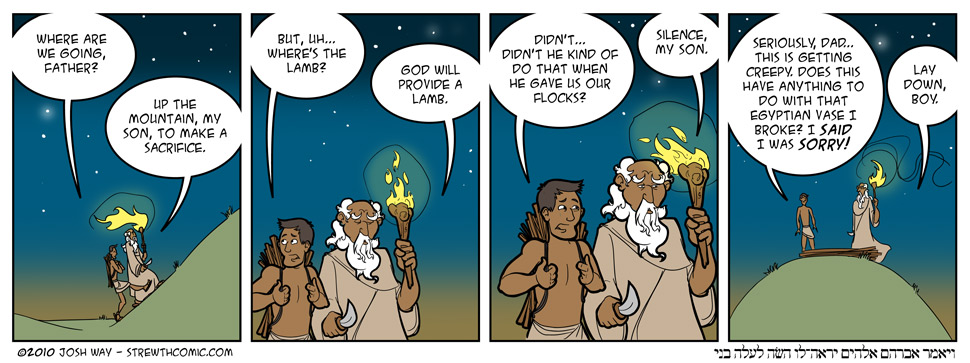
And then we come to our final passage for today, chapter 22 and the infamous story of Abraham and the sacrifice of Isaac. This is the text:

[22:1] Some time later, God put Abraham to the test. He said to him, “Abraham!” And he answered, “Here I am.” [2] He said, “Take your son, your favored one Isaac, whom you love, and go to the land of Moriah, and offer him there as a burnt offering on one of the hills which I will point out to you.” [3] Abraham rose early in the morning, saddled his donkey, and took two of his servants with him and his son Isaac. He split the wood for the burnt offering and set out for the place of which God had told him. [4] On the third day Abraham lifted up his eyes and saw the place from afar.

And jumping ahead to verse 9:

[9] When they came to the place of which God had told him, Abraham built the altar there and laid out the wood and bound his son Isaac. He laid him on the altar, on top of the wood. [10] Then Abraham picked up a knife to slaughter his son. [11] But an angel of the LORD called to him from heaven and said, “Abraham, Abraham!” And he said, “Here I am.” [12] He said, “Do not lay your hand on the boy or do anything to him, for now I know that you fear God, seeing you have not withheld your son, your favored one, from me.” [13] And Abraham lifted up his eyes and looked, and behind him was a ram, caught in a thicket by his horns. And Abraham went and took the ram and offered it up as a burnt offering in place of his son.

This is one of those Bible stories which frustrates and angers modern readers – particularly when read out of context or as a Sunday School lesson about God. Why is God demanding a human sacrifice? Why does he put Abraham through this ordeal after everything it took for Isaac to be born? There are not necessarily easy answers to these objections, but what we can do is briefly look at the context and literary features of the text to get a better handle on it.

The first verse plainly says “God tested Abraham.” The author of this tale doesn’t want us to think for a moment that God would ever demand a real human sacrifice. The practice is viewed as repugnant in all the rest of the Bible. So there must be some lesson God is trying to teach Abraham. The key, I think, is a verb that is repeated throughout this and all of the Abraham passages: the Hebrew verb “ra’ah,” meaning “to see.” Twice in the snippet we read from this chapter, it says that Abraham “lifted up his eyes and saw” something. And the location of the sacrifice is “Moriah,” which looks like it’s derived from “ra’ah.”

Remember back in the song in Genesis 1 when God “saw” that what he created was good? In biblical thinking, God as the unlimited creator is the only one qualified to make determinations of “good” or “bad.” Adam and Eve “saw” that the forbidden fruit was “good,” so they ate it, and cursed man to a life of conflict and compromise as everyone “sees” for him or herself what is “good.” All throughout his adventures, Abraham is “seeing” things for himself. In this chapter, God puts him to the test, and causes him to “see” without making his own judgments. He could have said, “No way, God, are you CRAZY?” But he obeyed, and trusted that God would provide an animal to sacrifice. In the end, God says “now I know that you FEAR me…” The Hebrew verb “to fear” is “yi’rah,” which looks like the 3rd person conjugation of “ra’ah”, “he sees,” and this pun is often exploited in the Bible. You can “fear” (or “trust”) God, or you can “see” for yourself. God teaches Abraham how to do the former.

The rest of Abraham’s story is about the death and burial of Sarah, for whom he buys a plot of land in Canaan which expands his claim on the territory. Eventually he is buried there along with his wife. We also hear of Isaac’s youth and his relationship with his wife Rebekah. When they marry, surprise surprise, she is barren, but God opens her womb and she gives birth to twins: Esau and Jacob…

And that’s the highlight reel from the life of Abraham. We left out a few bits for time, including Abraham’s loser nephew Lot and the colorful townships of Sodom and Gomorrah. Send me an email or a voicemail if you want to talk about those in a future show or supplement.

Israel’s ancestor stories may be culturally peculiar and strange to us, but let’s remember the HISTORY and LITERATURE behind the book. When Israel finally found their way into Canaan, hundreds of years later, the last thing most of them wanted to do was settle down. By the time they came out of the wilderness, the generation that had escaped Egypt had passed on, and the new generation had grown accustomed to wandering, just like their ancestors did. The Abraham stories functioned as a reminder that the earliest Israelites – called Hebrews – had been through all this before: the wandering, the lure of Egypt, the conflict with Canaan’s current inhabitants, it was all the same old story. This is not a collection of morality tales or a religious handbook, it’s a reminder to ancient Israel of who they are, where they’ve been, and where they’ve got to go. It’s an ultimatum: choose to be Israel, or lose the covenant forever.

This has been BOOK, a bible podcast for everybody. I’m Josh Way. If you enjoyed this podcast, I urge you to share, blog, like, and tweet it to your online friends and family. If you have any comments, questions or constructive feedback, email me at book@joshway.com. You can also leave a voicemail at 801-760-3013, and maybe I’ll answer it on the podcast. Read the BOOK blog and find more content at BOOK.JOSHWAY.COM. That’s it for me, Bible pals. I’ll catch you next time.
Download MP3

August 21, 2012 0

Episode 05 – Deluge-ional

By in Blog, Podcast

[TRANSCRIPT]

In my left hand is a filled-in book of Halloween Mad-Libs. In my right hand is a Bible. Let’s do a show about… THE BIBLE.

[INTRO MUSIC]

Hello, and welcome to BOOK, a Bible podcast for everybody. I’m Josh Way. Today we continue our journey through Genesis, the first scroll of the five-part Torah, the family album of the ancient nation of Israel. We have a lot of ground to cover today, but before we dive in, I want to say a little more than we’ve said so far about the literary structure of the book we’re reading.

In just a few short chapters we’ve already seen how many different stories, themes, genres, and authors have come together to form the chunk of text we call Torah. These include songs, fables, genealogies, laws, and histories. We shouldn’t be surprised or concerned when the tone and style of writing changes from bit to bit, while the themes and trajectories stay consistent and familiar. But I want to say a word in particular about this first section of Genesis – the first eleven chapters, to be precise.

In a book that appears to have been edited together from many sources, this first collection of legends and stories – often referred to as the “primeval” or “pre-historical” material – is by far the most unique and peculiar. The primeval material covers everything from creation to the so-called “Tower of Babel” in what amounts in our Bibles to only eleven chapters. The pace is quick and the literature is diverse, and when we hit chapter twelve and Abraham, things slow down and it’s clear that the story of Israel has properly begun. Basically, the pre-historical texts function as a tether between creation and the story of Israel.

The varied – and often problematically vague and truncated – stories of Genesis 1-11 are held together by two major concerns, our old friends LAND and OFFSPRING. Every story, no matter how strange or seemingly disconnected, has something to do with the possession or loss of land, or the possession or loss of lineage, or both. This is the key to keeping our eye on the text even when things get rough.

This brings us to Genesis 6 and following, and the familiar old story of Noah and his ark. We’ll peel back the layers on this wacky old tale in a moment, but I wouldn’t be a very good Bible podcast talking guy if I didn’t deal with a very strange bit of text at the beginning of the chapter, verses 1-4:

[1] When men began to multiply on the face of the earth and daughters were born to them, [2] the sons of god saw how beautiful the daughters of men were and took wives as they pleased. [3] The LORD said, “My breath shall not remain in man forever, since he is flesh. His days shall be 120 years.” [4] It was then that the nephilim appeared on the earth, and also afterward, when the sons of god lived with the daughters of men who bore them children. These were the heroes of old, the men of renown.

This brief and odd passage apparently caused as much speculation in the ancient world as it does today. Who are the “sons of god?” Who are the “nephilim?” There are many interpretations of these verses, but two in particular represent the range of possibility. One is a thoroughly supernatural reading, and the other is more practical and earthbound.

Tradition says that the “sons of god” are angels who came down to earth and mated with human women, creating a race of giants called the “nephilim.” This interpretation was clearly favored at a point much later in Israel’s history, as it forms the basis of the Book of Enoch, one of the non-biblical Jewish texts we talked about in a previous podcast. Enoch tells the story of these angels, their earthly sex-capades, and their subsequent punishment. The book of Enoch is quoted in the New Testament, suggesting that this version of the story would have been well-known to Jews at the time of Jesus.

Modern scholarship has offered an alternative view, however, one which makes a little more sense of the text in its historical and literary context here in the Torah. It’s true that the phrase “sons of god” in ancient literature often refers to angels or heavenly beings. But the phrase has another well-known ancient connotation, as it was frequently self-applied by the kings of old who saw themselves as divine representatives of local gods. In this reading, the “sons of god” are the kings of the great city states established by the men of Cain’s genealogy in chapter four. The “daughters of men,” then, refers to the offspring of the “normal” people from Seth’s line in chapter five. The point apparently being, that the world moved on, society evolved, people mingled and married, and the earth was populated. It’s just a description of early life on earth.

The benefit of this reading is that it connects with what came before, and as we’ll see, with what is to come. But we still have to deal with these “nephilim” characters. Tradition says that these are giants, perhaps even monsters, but you’ll notice that the text here doesn’t actually say that. “Nephilim” comes from the Hebrew verb “naphal,” and just means “fallen ones” or “losers.” The “giants” thing comes from the scroll of Numbers later in the Torah, where a specific group of nephilim are described as “giants.” Here in Genesis 6, however, they may simply be the offspring of kings and women, the “heroes of old.” Important to note, however, that in the ancient Israelite mindset, “men of renown,” are not heroes in the way we would expect. They are brutes, men who carve out their renown through violence and oppression. These are bad guys.

And that provides the connection to what immediately follows, the story of Noah and the great flood. Here’s the rest of Genesis 6:

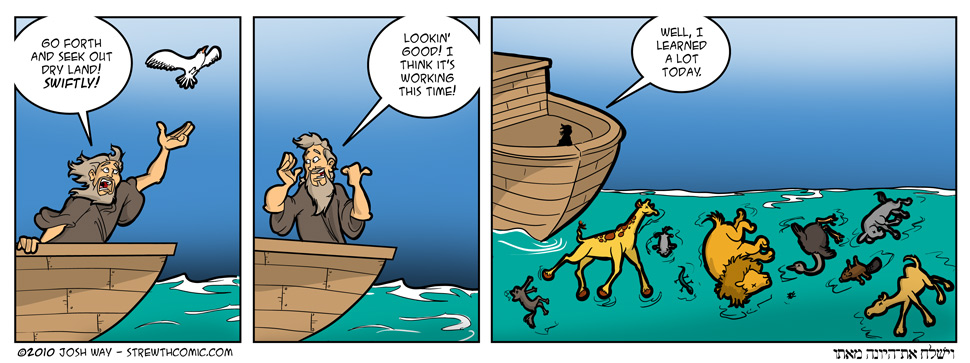
[5] The LORD saw how great man’s wickedness was on earth, and that every intention of his mind was only evil all the time. [6] And the LORD regretted that he had made man on the earth, and it grieved his heart. [7] So the LORD said, “I will blot out from the earth the men whom I created, along with the beasts and creeping things and birds of the sky, for I regret that I made them.” [8] But Noah found favor in the eyes of the LORD.

[9] These are the generations of Noah. Noah was a righteous man, blameless in his time. Noah walked with God. [10] Noah fathered three sons: Shem, Ham, and Japheth.

[11] The earth became corrupt in God’s sight, and the earth was filled with violence. [12] When God saw how corrupt the earth was, for all flesh had corrupted its way on the earth, [13] God said to Noah, “I have decided to put an end to all flesh, for the earth is filled with violence because of them. I am about to destroy them along with the land. [14] Make yourself an ark of gopher wood. Make compartments in the ark, and cover it inside and out with pitch. [15] This is how you are to make it: the length of the ark 300 cubits, its width 50 cubits, and its height 30 cubits. [16] Make an opening for daylight in the ark, and finish it within a cubit of the top. Put an entrance to the ark in its side. Make it with bottom, second, and third decks. [17] For my part, I am about to bring the flood waters upon the earth to destroy all flesh in which there is breath of life. Everything on the earth will die. [18] But I will establish my covenant with you, and you will enter the ark with your sons, your wife, and your sons’ wives. [19] And of all that lives, of all flesh, you shall take two of each into ark to keep alive with you. They shall be male and female. [20] From birds of every kind, cattle of every kind, every kind of creeping thing on earth, two of each shall come to you to stay alive. [21] For your part, take with you every sort of food and store it away, to serve as food for you and for them.” [22] Noah did this. He did all that God commanded him.

Most modern readers don’t know what to do with a story like this. The great Ricky Gervais has a comedy routine where he simply reads this story out of the Bible, without comment, and his audience laughs with derision. The story of Noah simply doesn’t meet the post-enlightenment criteria of a believable or relatable tale. But once again, I would suggest that history and literature are the key to appreciating the place and value of a story like this one.

As with many other stories in the primeval chapters of Genesis, we do well to look to Israel’s neighbors and their mythic traditions which often shed light on the biblical material. In the 19th century archaeologists discovered the Mesopotamian epic of “Gilgamesh,” which among other startling things contains an account of an ancient flood with many striking parallels to the biblical story of Noah – as well as some striking differences.

Of course the existence of these and other similar flood narratives points to the probability of some kind of ancient historical reality. Whatever that reality was, all we’ve got are the tales which different societies told to make sense of the event. And a quick comparison between the Israelite and the Mesopotamian and Babylonian versions reveals a lot. We’ll contrast the legends at three points: 1) the cause of the flood, 2) the hero and the method of survival, and 3) the aftermath.

First, the cause of the deluge. In the Babylonian myth, the gods are distracted by the noise of life on earth and can’t get any sleep, so they send the flood to silence man so they can get some rest. In Genesis, Adonai Elohim – the god of Israel – sees the violent sinfulness of men spreading as they populate the earth, and so “regrets” that he ever created them. Remember the creation account and the significance of water, which represents chaos and evil. Essentially, God decides to “uncreate” the earth by returning it to its pre-creation state. It’s like hitting Ctrl-Alt-Del on the world.

Next, the “hero” of the tale and the method of survival. In the Gilgamesh epic, the hero is Utnapishtim, a Sumerian King who employs his own cunning and strength to build a boat and out-row the flood waters. He is a mighty ruler, basically one of the descendents of Cain from the Bible, a king who built a city. He is the model of Mesopotamian pride: strong and clever enough to outwit the gods and save life on earth.

In Genesis, the protagonist is Noah, a “blameless man.” He’s a normal guy with a family, someone who obeys God and knows his place. He is basically a good Israelite before there were any Israelites. He apparently keeps the sacrificial law (which won’t be given for thousands of years) and he distinguishes between clean and unclean animals. In one sense this is very odd and perhaps anachronistic. Then again, given the nature of the Torah and the way ancient people told and retold ancient stories to say something about themselves and their present reality, it shouldn’t be very surprising that the one good guy in the ancient flood story looks just like a model citizen of future Israel.

Noah builds an “ark,” which is not just a big boat. The word appears in two other settings in the Bible: the ark of the covenant, and the Egyptian coffin in which Joseph is buried. What do all three have in common? They are all boxes, simple containers. The difference between Utnapishtim and Noah is that one escapes by his wits and strength, and the other has no control over where the vessel is taken. God will decide where the ark comes to rest. And while the ark contains only Noah’s family and the many pairs of wild beasts, the boat in Gilgamesh also contains artists and craftsmen. It’s not just life on earth that’s being saved, but culture as well. We’ve already observed that the Hebrew Bible views culture as a counterfeit of what God created, but in Mesopotamia culture represents man’s glory, his achievement to spite and surpass the gods.

Then, third, there is the aftermath of the flood. Utnapishtim safely runs the boat aground and offers a sacrifice to the gods, who reward him and his wife with powers which make them “like the gods.” There is an understanding between the gods and the new demi-gods that nothing as destructive as the flood will ever happen again. Meanwhile in Genesis, Noah and his family exit the ark, and Noah also makes a sacrifice to his god. Here’s the text, from Genesis 8 and 9:

[20] Then Noah built an altar to the LORD and took some of every clean animal and every clean bird and offered burnt offerings on the altar. [21] The LORD smelled the pleasing aroma, and the LORD said to himself, “Never again will I curse the ground because of man, since the intentions of man’s mind are evil from his youth. Nor will I ever again destroy every living creature as I have done. [22] As long as the earth endures, seedtime and harvest, cold and heat, summer and winter, day and night shall not cease.”

[9:1] God blessed Noah and his sons and said to them, “Be fruitful and multiply and fill the earth. [2] The fear of you shall be upon all the beasts of the earth and upon all the birds of the sky, upon everything that creeps on the ground and all the fish of the sea. They are given into your hand. [3] Every creature that lives shall be food for you. As with the green plants, I give you all of these. [4] You must not, however, eat flesh with its life-blood in it. [5] But for your own life-blood I will require a reckoning, as from every beast. Of man too, will I require a reckoning for human life, of every man for that of his fellow man.

[6] “Whoever sheds the blood of man,
by man shall his blood be shed,
for God made man in his own image.
[7] Be fruitful, then, and multiply, abound on the earth and increase in it.”

[8] Then God said to Noah and to his sons with him, [9] “I now establish my covenant with you and your offspring after you, [10] and with every living creature that is with you, birds, cattle, and every wild beast as well, all that came out of the ark, every living thing on earth. [11] I establish my covenant with you: Never again shall all flesh be cut off by the waters of a flood, and never again shall there be a flood to destroy the earth.” [12] God further said, “This is the sign that I set for the covenant between me and you and every living creature with you, for all future generations: [13] I have set my bow in the clouds, and it shall serve as a sign of the covenant between me and the earth. [14] When I bring clouds over the earth and the bow is seen in the clouds, [15] I will remember my covenant that is between me and you and every living creature among all flesh, so the waters shall never again become a flood to destroy all flesh. [16] When the bow is in the clouds, I will see it and remember the everlasting covenant between God and all living creatures, all flesh that is on the earth. That,” [17] God said to Noah, “is the sign of the covenant that I have established between me and all flesh that is on the earth.”

So God blesses Noah and his family, and gives them a cool bonus: they can now eat meat! I’d say that was worth the death of 99.8% of the earth’s inhabitants. Two very important things come out of the aftermath of the flood: the re-establishment of LAND and OFFSPRING (farming and repopulating the earth) as the main thrust of the story, and the introduction of a huge biblical idea – COVENANT.

This is the first of many times God will be depicted as making a covenant – that is, a treaty or agreement – with humans in the Torah. Given all the tension between God’s original purposes in creation and the selfish interests of humans, covenant is the way ancient Israel navigates life on earth. And the fact that covenants are usually sealed in the blood of animals shouldn’t be surprising, given what we observed in the last podcast about animal sacrifice in the ancient world. The exchange of blood for blood, life for life, is made explicit in this passage.

Just as LAND and OFFSPRING are the underlying themes of all Torah texts, CREATION and COVENANT are the driving themes throughout the rest of the Hebrew Bible, and – I would argue – the New Testament as well. We’ll get there eventually.

One more little bit to deal with for today. Here’s the strange and unexpected epilogue to the story of righteous Noah and his magic floaty box:

[18] The sons of Noah who came out of the ark were Shem, Ham, and Japheth – Ham being the father of Canaan. [19] These three were the sons of Noah, and from these the people of the whole earth were dispersed.

[20] Noah, a tiller of the soil, was the first to plant a vineyard. [21] He drank of the wine and became drunk and lay uncovered in his tent. [22] Ham, the father of Canaan, saw the nakedness of his father and told his two brothers outside. [23] But Shem and Japheth took a cloth, laid it on both their shoulders, and walked backward and covered the nakedness of their father. Their faces were turned away, and they did not see their father’s nakedness. [24] When Noah awoke from his wine and learned what his youngest son had done to him, [25] he said,

“Cursed be Canaan. The lowest of servants shall he be to his brothers.”

[26] He also said, “Blessed be the LORD, the God of Shem, and let Canaan be their servant. [27] May God enlarge Japheth,and let him dwell in the tents of Shem, and let Canaan be their servant.”

[28] After the flood Noah lived 350 years. [29] All the days of Noah were 950 years, and he died.

Noah and his sons have a redneck holiday, and Noah lashes out and curses his grandson, who wasn’t even involved in the kerfuffle. What’s going on here? The clue to the whole thing is the grandson’s name, Canaan. Canaan, of course, is the father of the nation which will occupy the so-called “promised land,” the patch of earth which the farmers and shepherds of Israel will eventually claim as their own.

The people and gods of Canaan will prove a continual foil AND lure for the people of Israel for the rest of their national life. And while the conflict between Israel and Canaan is often viewed from a modern perspective in terms of holy war and racial cleansing, it’s remarkable to discover here in the Torah that Israel and her biggest enemy are in fact COUSINS. This tension hangs thick in the air for the rest of the Hebrew Bible.

For most modern readers, the story of Noah is nothing more than a juvenile relic of ancient etiology, offering a simplistic account of the origin of the rainbow. But I would suggest that the real value of the story is the view it gives us into the mindset of the people who wrote the Bible. It has a lot to say about the way Israel viewed itself, and how it distinguished itself from its neighbors and enemies.

For Babylon and Mesopotamia, the big flood was a clash between heroes and gods, a chance for man to prove his mettle and carve out his own path. For Israel, the flood was a second chance for creation, a new opportunity for humans to live in peace with God and each other. But already by the end of the account, man is in trouble again, as sin begins to divide the only family that’s left. The stage is set for the story of Abraham, which is the beginning of Israel’s story.

This has been BOOK, a bible podcast for everybody. I’m Josh Way. If you enjoyed this podcast, I urge you to share, blog, like, and tweet it to your online friends and family. If you have any comments, questions or constructive feedback, email me at book@joshway.com. You can also leave a voicemail at 801-760-3013, and maybe I’ll answer it on the podcast. Read the BOOK blog and find more content at BOOK.JOSHWAY.COM. That’s it for me, Bible pals. I’ll catch you next time.
Download MP3 Audio

Tags: , , , , , ,

August 12, 2012 1

Episode 04 – Cain & Abel

By in Blog, Podcast

Cain and Abel Comic Strip

[TRANSCRIPT]

Well, we made it through a song, a couple of magic trees and a talking snake, but nothing has prepared us for what we face today, my friends. Buckle up and prepare yourselves for… GENEALOGIES. That’s right, genealogies: lists of people you’ve never heard of who begat other people you’ve never heard of. Do all these names mean anything? Do they contribute anything to the Bible’s message, or were the authors just being paid by the word?  Well today we’ll find out just what the deal is with all those lists of names in the Bible. Oh, and there’s also sex, murder, and polygamy. All this and more on a little show I like to call…BOOK.

[INTRO MUSIC]

Hello, and welcome to BOOK, a Bible podcast for everybody. I’m Josh Way. Today we continue our tour through the Torah, the five-part book which tells the story of a family called Israel and their long and sordid adventure to become a nation.

By the way, in case you’re wondering, we’re not necessarily going to cover every single chapter in the Bible one or two at a time like we have been. Sometimes we’ll skip ahead or around, and sometimes we’ll look at a whole book, or even a group of books at once. But for now, the material at the beginning of Genesis is so diverse and eclectic and strange, we really need to take the time to see what’s going on and how it all ties together. The themes, genres and devices we encounter here in Genesis are going to pop up again and again in later books, and we’ll get better at recognizing them and learning how to read the Bible quicker and smarter.

So just one chapter today, and it’s a doozy. Literarily (if I may profane the English language), this is a continuation of the Adam and Eve narrative we examined last time, though there are some new elements for us to deal with – particularly those pesky genealogies. But we’ll get there in time. Thematically speaking, we’re looking at the same strands: OFFSPRING and LAND. This is a story about a family and their relationships with God, the earth, and each other.

So here is Genesis Chapter 4:

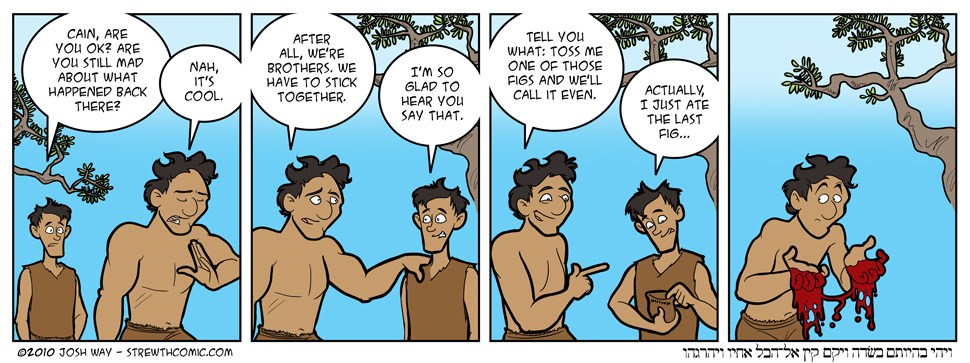
[1] Now Adam knew Eve his wife, and she conceived and gave birth to Cain, saying, “I have gotten a man with the help of the LORD.” [2] She then bore his brother Abel. Abel became a keeper of sheep, and Cain a worker of the soil. [3] In the course of time Cain brought an offering to the LORD from the fruit of the soil, [4] and Abel, for his part, brought of the best portions of the firstborn of his flock. And the LORD had regard for Abel and his offering, [5] but for Cain and his offering he had no regard. So Cain was very angry, and his face fell. [6] The LORD said to Cain, “Why are you angry, and why has your face fallen? [7] If you do well, will you not be accepted? And if you do not do well, sin is crouching at the door. It has it in for you, but you must be its master.”

[8] Cain spoke with his brother Abel. And when they were in the field, Cain set upon his brother Abel and killed him. [9] The LORD said to Cain, “Where is your brother Abel?” He said, “I do not know; am I my brother’s keeper?” [10] Then he said, “What have you done? The voice of your brother’s blood is cries out to me from the ground! [11] So now you are more cursed than the ground, which opened its mouth to receive your brother’s blood from your hand. [12] If you work the soil, it shall no longer yield its strength to you. You shall become a ceaseless wanderer on earth.” [13] Cain said to the LORD, “My punishment is too great to bear! [14] Since you have banished me today from the soil, and I must avoid your face and be a ceaseless wanderer on the earth – anyone who meets me will kill me!” [15] The LORD said to him, “I promise, if anyone kills Cain, sevenfold vengeance will be taken on him.” And the LORD put a mark on Cain, lest any who met him should kill him. [16] Cain went away from the presence of the LORD and settled in the land of Nod, east of Eden.

[17] Cain knew his wife, and she conceived and gave birth to Enoch. So when he built a city, he named the city after his son, Enoch. [18] To Enoch was born Irad, and Irad fathered Mehujael, and Mehujael fathered Methushael, and Methushael fathered Lamech. [19] Lamech took two wives for himself. The name of one was Adah, and the name of the other Zillah. [20] Adah bore Jabal; he was the ancestor of all who dwell in tents and have herds. [21] His brother’s name was Jubal; he was the ancestor of all who play the lyre and pipe. [22] As for Zillah, she bore Tubal-cain, who forged all implements of bronze and iron. The sister of Tubal-cain was Naamah.

[23] Lamech said to his wives:
“Adah and Zillah, hear my voice;
O wives of Lamech, listen to what I say:
I have killed a man for wounding me,
and a young lad for striking me.
[24] If Cain’s revenge is sevenfold,
then Lamech’s is seventy-sevenfold.”

[25] Adam knew his wife again, and she gave birth to a son and called his name Seth, for she said, “God has provided another child for me instead of Abel, because Cain killed him.” [26] To Seth also a son was born, and he called his name Enosh. At that time people began to invoke the LORD by name.

The first thing we notice about this chapter is that, although it is a clear continuation of the story in Chapter 3, it is also designed to work as an independent unit. And how do we know that? Because of a literary feature called “inclusio.” “Inclusio” is a fancy way of saying the passage begins and ends the same way. In verse 1, Eve gives birth and makes a statement, then at the end in verse 25 she gives birth and makes a statement. This is typical Hebrew storytelling.

And while the repetition gives us a clue as to the structure of the text, the subtle differences in the opening and closing statements say something about the meaning. The first time Eve gives birth, her statement is a little goofy and boastful. She’s basically saying, “Hey, I made a dude, and God helped!” At the end, she is wiser and more humble: “God has provided a child for me!” It’s as though giving birth for the first time filled Eve with a sense of creative power and grandeur, but the unsavory events of the chapter brought the ugly reality of life outside the garden into grim focus. She did make a dude, but he turned out to be a murderer.

To appreciate the story of Cain and Abel, their sacrifices, and the violence between them, we have to remember the historical reality, not of Cain and Abel, but of Israel which told this story. We’ve already observed that the story of Israel is the story of shepherds and farmers occupying the same land. Farmers worked their own land, while shepherds moved around looking for any land that could support their flock. Conflict between the two was inevitable, and Cain and Abel are a dramatization of that conflict. Cain is a farmer, and his “offering” comes from his crop. Abel is a shepherd, and his “offering” comes from his flock. It’s one thing when this conflict is between strangers in the wilderness, but in this story and in Israel’s reality, the clashing farmers and shepherds are family. They need each other, as we explored in Genesis 3.

Now we should say something here about SACRIFICE. This is something that modern people find creepy, but there’s really no reason we should if we understand it correctly. A little confession: when I was a kid, raised in the church, I was thoroughly weirded out by animal sacrifice in particular. I read the Bible, and I could not understand why God was so insistent that people spill animal blood all over the place. It made no sense, and the theological answers to my objection didn’t help much.

Of course now that I’ve “grown up” and learned more about the ancient world, I know why animal sacrifice doesn’t make sense to us. It’s because of groceries. It’s because our food is extracted and synthesized and preserved and packaged and chilled and sold to us. Very few of us have to slit an animal’s throat so we can have lunch, or clothing, or a tent. Because there was no “middle man” between consumers and animal resources in the ancient world, people were keenly aware that animals actually had to die so they could have the things they needed. It’s that simple. It’s not that gods demanded that people spill animal blood, it’s that people were doing it already and developed a religious way of acknowledging the exchange – an animal’s life, for a meal. Or a tent. Or a garment. Sacrifices were done in the name of gods to show appreciation for the provision of the animal.

So Cain and Abel offer sacrifices to God. Cain brings an offering of fruit or perhaps grain, and Abel brings a meat offering. They’re saying “thank you” to God in the normal course of their work. For reasons that the text does not explain, God is pleased with Abel, and displeased with Cain. Interpreters have gone nuts with this, trying to figure out what is pleasing and displeasing about each sacrifice, but I think the text is intentionally vague. As a result, we understand and empathize when Cain becomes angry.

Before the events of Genesis 3, Adam and Eve trusted that God knew what he was doing and they simply enjoyed the benefits of creation. Once they had gained the “knowledge of good and bad,” they became keenly aware of their own interests and limitations. Ambition plus limitation equals frustration. Cain inherits this condition, which we might call “humanity,” and he rages against God.

But anger itself isn’t presented as “sin.” The first sin is when Cain follows his frustration through to its unfortunate climax and takes his brother’s life. Granted the allegorical nature of this story we can still imagine that the first murder was something of a surprise to both parties. Cain forsakes his commitment to the three relationships of the garden – BREATH, FOOD, and FAMILY – and to his horror breaches the boundaries of mortality.

The aftermath echoes the previous chapter, when God comes looking for the man and asks him a question: “where is your brother?” Cain’s famous answer strikes at the heart of all human conflict: “Am I my brother’s keeper?” The answer, of course, is YES. That is what Cain was meant to be above all else.

Sin, according to the Bible, is not simple rule-breaking or villainous plotting. When Cain says “my guilt is too great for me to bear,” he is expressing the full Hebrew concept of sin. The word here is “aven,” which simultaneously connotes trespass, guilt, and punishment. They are all wrapped up in the same experience. The weight of guilt from a sinful act is also the punishment for it. There is no “eternal damnation” in the Hebrew Bible as such. The danger of sin, according to this story, is threefold:

1) It ISOLATES THE INDIVIDUAL. Cain forfeits his role in family and society and is doomed to wander.

2) It OPPRESSES THE INNOCENT. Abel’s blood “cries out from the ground,” a common Hebrew image of injustice.

3) It PROVOKES RETALIATION from others. God must provide protection and refuge for Cain, lest others seek to “pay him back” for what he has done.

These are the foundational principles of Israel’s system of justice, which we’ll investigate further in future podcasts.

Then the text says that Cain went off and “built a city.” Not the sort of thing we typically attribute to an individual, but here’s the point: Cain no longer has a place in the agrarian society founded by his family. A city, in ancient semitic thought, represents a human attempt to order the elements of the earth. It’s a sort of counterfeit creation, an alternative way to live and breathe, and eat, and love. It’s not that cities are “evil,” but they are made necessary by human ambition and isolation. This complicated understanding of urban life and civilization is one of the keys to understanding the genealogy that comes at the end of the chapter.

So now we come to the first of many genealogies in the Bible. This is one is actually mercifully short and peppered with interesting narrative details. But after a while, these lists start to add up and the names all run together, and we wonder why the heck any of this matters to anyone.

Biblical genealogies are actually very important to the structure and meaning of narratives. They provide connective tissue for otherwise disparate elements, and they trace the lineage of important figures throughout the sweep of Israel’s history. However, it’s important to understand here at the start that Hebrew genealogies are very stylized and artistic, and don’t always behave the way we want them to.

For example, these early Genesis genealogies connect historical figures like Jacob and Moses to legendary characters like Adam and Cain. Additionally, we find that Hebrew genealogies are limited to a certain, symbolically significant number of generations. This list, Cain’s genealogy, has seven generations (beginning with Adam), which is three short of the more typical ten. Even the life spans given in the genealogies appear to be stylized.  We’ll talk about the significance of the numbers in a moment, but here’s the immediate fallout of this observation: Attempts to quantify and add up the generations in Genesis to “prove” or “disprove” assertions about the age of the earth are simply not in tune with the way these lists work.

The Cain genealogy is better understood, perhaps, in contrast with the genealogy in the next chapter, chapter five. It’s longer and I won’t bore you by reading, but go ahead and check it out on your own. It’s the lineage of Seth, Cain’s brother, and beginning with Adam it has the expected ten generations. In Hebrew thought, ten is the number of completeness and perfection. God speaks ten times in the song in chapter one. God gives ten words or “commandments” in the book of Exodus. Ten of something is enough, just the right amount.

So Cain’s line, with its seven generations, is incomplete. Fewer than ten. But think also about the significance of the number seven. This is the number of creation, of the days of the week in the hymn in chapter one. Cain’s line includes city builders, craftsmen, and musicians. These are culture makers, humans who practice creation. To modern readers like us, this is only good. This is where art and music and expression come from. But in Genesis, this is bittersweet because culture is a pale copy of what God already established. Meanwhile, the ten “perfect” generations in Seth’s genealogy sound very mundane to us. Each one (with a notable exception) plays out the same way: “He lived, he fathered, and then he died.” These are normal people, people who breathed, ate, and loved, then passed on. Sounds boring to us, but the text clearly sees these as the “faithful” people, the “simple” people. This contrast is also illuminated by two small bits at the end of this chapter.

The bit about Lamech toward the end of Cain’s lineage, is an indication of just how far that line got from where they had started. Lamech is a braggart, a polygamist, and a murderer. But what’s more, he’s proud of it. Cain hid from his sin, Lamech celebrates it. This is also the first mention of polygamy in the Bible, another subject that is sorely misunderstood. Many assume that the Bible endorses polygamy based on the fact that many of the so-called “heroes” of the Bible practiced it. Of course, this also assumes that the point of Bible stories is simple moral exemplification, that these men are supposed to be “heroes” in the first place, and that the Bible must explicitly condemn something or else it is endorsing it. Just read the Genesis family stories (or stay tuned to BOOK), and you’ll discover that in every generation where it is found, polygamy is portrayed as disastrous and counterproductive. Lamech is Exhibit A.

Over against the negative portrait of Cain’s descendants, there is the comment about Seth’s line that “at that time people began to invoke the Lord by name.” Keep in mind that “Lord” is not a generic religious category, but the specific personal name of Israel’s God. The claim here is that these descendants of Seth at some point began to encounter and worship Adonai, the God who won’t be explicitly revealed to Israel until Exodus chapter four. Whatever else this might mean, it clearly means that Israel identifies itself more with Seth’s family than with Cain’s.

I know this genealogy and numeric symbolism stuff is hard to take. After a while it starts to sound like “Bible Code” nonsense. It can hurt our brains and make the text seem impenetrable, but let’s not get hung up on it. Suffice to say, numbers and symbols and repetition are important in Hebrew writing, and would have been effortlessly understood by the original hearers. We have to work a little bit to meet them where they are.

And that’s Genesis 4. Next time we’ll take a look at Noah and the big flood, another one of the Bible’s overly-familiar but misunderstood stories.

This has been BOOK, a bible podcast for everybody. My name is Josh Way. If you enjoyed this podcast, I urge you to share, blog, like, and tweet it to your online friends and family. If you have any comments, questions or constructive feedback, email me at book@joshway.com. You can also leave a voicemail at 801-760-3013, and maybe I’ll answer it on the podcast. Read the BOOK blog and find more content at BOOK.JOSHWAY.COM. That’s it for me, Bible pals. I’ll catch you next time.

Download MP3

Tags: , , , ,

August 7, 2012 4

Episode 03 – Breathe. Eat. Love.

By in Blog, Podcast

Garden of Eden Comic

[TRANSCRIPT]

In my left hand is a pamphlet about bus safety. In my right hand is a Bible. Let’s do a show about… THE BIBLE.

[INTRO MUSIC]

Hello, and welcome to BOOK, a Bible podcast for everybody. I’m Josh Way.

Many ideas have been hung upon the Bible story of Adam, Eve, a talking snake and a piece of fruit: “The Fall of Man,” “Original Sin,” the loss of sexual innocence, foundations of marriage, snake evolution, and the perils of produce. Setting aside our own assumptions and agendas, we might rediscover an outrageous ancient text with deeply human and urgently relevant themes. If you can get past the talking animals and cherubim, this is a story about humans, about US.

Before we look at the story in detail, let’s have a quick recap of where we’ve come so far and a look at where we’re going:

Genesis is part one of the five-part Torah, which is a collection of foundational documents compiled by the family of Israel when it became the nation of Israel. These are the songs, legends, laws, histories and genealogies of a group of people who had once been wanderers, but were now settling together in one place for the first time. These songs and stories were shared around campfires and passed down through many generations before being written down and compiled in the Torah. As a result, the individual units of the Torah are very diverse, and the genre can change from chapter to chapter without warning. But as we observed in the last show, two major themes run through all of the material and give it coherence. These themes are: OFFSPRING, because this is the story of a family, and LAND, because nomadic shepherds are becoming landowners and farmers.

Keep this big picture in mind as we turn now to the text in question. We’re going to consider Genesis chapters two and three as a single unit today, but let’s read one chapter at a time to keep our bearings. So here’s chapter two (starting with verse 4):

4 These are the generations of heaven and earth when they were created.

When the Lord God made earth and heaven, 5 when no shrub was yet on earth and no grass had yet sprung up because the Lord God had not sent rain on the land, and there was no man to work the soil, 6 but a mist would go up from the land and water the surface of the earth, 7 the Lord God formed the man from the dust from the ground and breathed into his nostrils the breath of life, and the man became a living creature. 8 The Lord God planted a garden in Eden, in the east, and there he put the man whom he had formed. 9 And from the ground the Lord God caused to grow every tree that is pleasant to the sight and good for food, with the tree of life in the middle of the garden, and the tree of the knowledge of good and evil.

10 A river flowed out of Eden to water the garden, and then divided and became four branches. 11 The name of the first is the Pishon, the one that flowed around the whole land of Havilah, where gold is 12 (the gold of that land is good; bdellium and onyx stone are there). 13 The name of the second river is the Gihon, the one that wound through the whole land of Cush. 14 The name of the third river is Tigris, the one that flows east of Assyria. And the fourth river is the Euphrates.

15 The Lord God took the man and put him in the garden of Eden to till it and tend it. 16 And the Lord God commanded the man, saying, “You are free to eat of every tree of the garden, 17 but as for the tree of the knowledge of good and bad, you must not eat of it, for as soon as you eat of it you will die.”

18 The Lord God said, “It is not good for man to be alone; I will make a helper fit for him.” 19 So the Lord God formed out of the ground all the wild beasts and all the birds of the sky and brought them to the man to see what he would call them, and whatever the man called each living creature, that was its name. 20 The man gave names to all the cattle and to the birds of the sky and to all the wild beasts, but for Adam no fitting helper was found. 21 So the Lord God caused a deep sleep to fall over the man, and while he slept he took one of his ribs and closed up the place with flesh. 22 And the rib that the Lord God had taken from the man he made into a woman and brought her to the man. 23 Then the man said,

“This one at last is bone of my bones
and flesh of my flesh.
This one will be called Woman,
because she was taken out of Man.”

24 Therefore a man will leave his father and his mother and cling to his wife, so that they shall become one flesh. 25 The two of them were naked, the man and his wife, and they were not ashamed.

We’ve only just moved from chapter one to chapter two, and we’ve already encountered our first major genre shift. Genesis 1 was a song celebrating the natural order of the universe, and now we have a narrative story which seems less concerned with the cosmos than it is with human beings and soil. Our twin themes of OFFSPRING and LAND are in full view, but in a more specific and colorful way.

A few literary features stand out. The opening line, “These are the generations of heaven and earth” is part of a formula which gives the whole Torah its structure. There are eleven of these “generations of” introductions throughout Genesis, and one more in the scroll of Numbers to complete the formula and remind us that the Torah is really telling just one big story. That’s a total of twelve, which of course is the number of tribes which make up the family of Israel.

The most notable difference between this account of creation and the one in Genesis 1 is the way that God is portrayed. In the creation hymn, God is elusive and distant, speaking commands from above and organizing the cosmos by his will. In this text, he is much more intimately involved in creation, forming man with his hands and breathing his own life into him.

Even the Hebrew words used to identify God are different in these two passages. In Genesis 1, he is “Elohim,” which is the more generic, formal word meaning simply “God” or even “gods” (!) In chapter two, he is called by the personal name of Israel’s God. Most English Bibles translate this “Lord,” after the Hebrew “Adonai,” the traditional substitute for the unspeakable holy name. Modern Jews simply call him “Hashem,” “The Name.” Scholars have tried to pronounce this name in different ways, from “Jehovah” to “Yahweh,” but the truth is, we don’t know how it’s pronounced. The Hebrew text is always obscured by unreadable vowels, since the name was never supposed to be uttered.

The point of all this is INTIMACY. The God of this creation story is personal and specific, and hands-on. This is Israel’s God, and this story is about how he shared his life and his creative power with human beings. In this account, man is given a proactive role in working the land and managing the animal kingdom. Humans are God’s representatives, entrusted with the stewardship of the earth’s resources. There is still accountability to the creator, evidenced by the single regulation concerning the special tree at the center of the garden, but humanity is given great freedom as well as responsibility.

The setting of this story is a garden. For most modern readers, a garden is a quiet place where you sit and enjoy “nature” as it were. But in the ancient world, a garden meant one thing: food. This is a place where humans take care of the land, and the land takes care of them by providing abundant food. The geographic details in this text, the list of “rivers,” has puzzled interpreters as to the exact location of the garden. There are theories which place Eden anywhere from Israel to Northern Africa to Mars (seriously). It seems pretty clear, geographic nitpicks aside, that the location is somewhere in the center of the Ancient Near East, the “world” as ancient Israelites knew it.

The last major event of this chapter is the creation of the woman as a partner for the man. Adam (whose name is related to the Hebrew words for “human” and “dirt”), is so excited to meet his mate Eve (whose name sounds like the Hebrew for “life-giver”) that he sings her a little song. And the little bow on the end of this chapter is that the two are united together, and they are “naked but not ashamed.” This isn’t only about physical nakedness and the shame that some societies attach to it. This nakedness denotes innocence, naivete. They are naked and vulnerable, but it’s OK. Their needs are met in their surroundings and in their relationships with God and each other.

Before we move on to the drama of chapter three, I want to distill the three distinct relationships we just encountered which form the thematic basis of this story, and much of the biblical literature. The three relationships at the heart of Genesis 2 are GOD, EARTH, and PEOPLE. Or, to put it another way, BREATH, FOOD, and SEX. This is central to the way the authors of the Bible look at life. These three relationships define what it is to be human. BREATH sustains life, moment to moment, FOOD nourishes and strengthens, and SEX enriches and literally multiplies life. This is the threefold blessing of creation.

But then things get weird… Now on to chapter three:

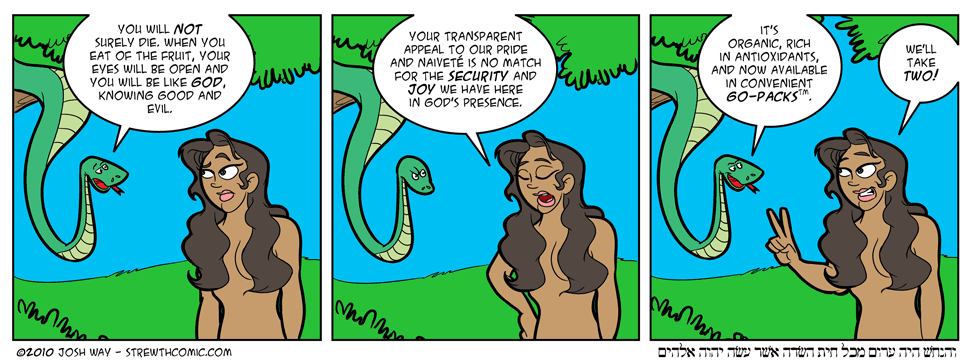
1 Now the serpent was the shrewdest of all the wild beasts that the LORD God had made. He said to the woman, “Did God really say, ‘You shall not eat of any tree in the garden’?” 2 The woman replied to the serpent, “We may eat of the fruit of the other trees in the garden. 3 It is only the fruit of the tree in the middle of the garden that God said, ‘You shall not eat it or touch it, lest you die.’” 4 And the serpent said to the woman, “You are not going to die. 5 But God knows that as soon as you eat of it your eyes will be opened, and you will be like gods who know good and bad.” 6 So when the woman saw that the tree was good for eating and a delight to the eyes, and that the tree was desirable to make one wise, she took of its fruit and ate. She also gave some to her husband, and he ate. 7 Then the eyes of both were opened and they knew that they were naked, and they sewed fig leaves together and made themselves loincloths.

8 They heard the sound of the LORD God moving through the garden in the cool of the day, and the man and his wife hid from the LORD God among the trees of the garden. 9 The LORD God called out to the man and said to him, “Where are you?” 10 And he said, “I heard the sound of you in the garden, and I was afraid because I was naked, so I hid.” 11 Then he asked, “Who told you that you were naked? Did you eat of the tree from which I commanded you not to eat?” 12 The man said, “The woman you put with me, she gave me of the tree, and I ate.” 13 And the LORD God said to the woman, “What is this you have done!” The woman replied, “The serpent duped me, and I ate.”

14 Then the LORD God said to the serpent,
“Because you did this,
you are more cursed than all cattle
and the wild beasts;
On your belly you shall crawl,
and dirt shall you eat
all the days of your life.
15 I will put enmity between you and the woman,
and between your offspring and her offspring;
He shall bruise your head,
and you shall strike at his heel.”
16 To the woman he said,
“I will intensify your pain in childbearing;
in pain you shall bear children.
Yet your desire shall be for your husband,
and he shall rule over you.”
17 To Adam he said,
“Because you did as your wife said
and ate of the tree
about which I commanded you,
‘You shall not eat of it,’
cursed is the ground because of you;
By toil shall you eat of it all the days of your life;
18 Thorns and thistles shall it sprout for you,
but your food shall be the grass of the field.
19 By the sweat of your brow
you shall get bread to eat,
until you return to the ground,
for from it you were taken;
for you are dust,
and to dust you shall return.”

20 The man named his wife name Eve, because she was the mother of all the living. 21 And the LORD God made garments of animal skins for Adam and for his wife, and clothed them.

22 Then the LORD God said, “Now that the man has become like one of us, knowing good and bad,  what if he should reach out his hand and take also from the tree of life and eat, and live forever!” 23 So the LORD God banished him from the garden of Eden to work the soil from which he was taken. 24 He drove out the man, and at the east of the garden of Eden he stationed cherubim and a flaming, ever-turning sword to guard the way to the tree of life.

Just when the story starts to seem relevant and relatable, suddenly we’ve got talking snakes and curses and cherubim. These elements immediately take us out of any reality the narrative may have had for us, but that’s only because we’re not familiar with ancient symbolic imagery. Today even most conservative Bible interpreters recognize that this is a mythic story which employs tropes and images which would have been familiar to ancient hearers, but which are all but lost on us. To focus on the veracity of a myth like this one is to miss the deep and powerful things it wants to say.

In many traditions, the serpent is just assumed to be Satan. In fact, the New Testament hints at that interpretation, most strongly in the similarly symbol-laden book of Revelation. “Satan,” or “hasatan” (“the accuser” in Hebrew), is a sticky subject,  and one I think we’ll save for another show as it is not explicitly mentioned anywhere in this text.

In most ancient cultures, the serpent held some symbolic significance. The snake has an obvious phallic association, and those who read this story as a fable of either sexual awakening or sexual shame latch onto that symbolism. That’s plausible, but there’s perhaps a more historically appropriate connection to be made.

In the mythologies of the pagan cultures which surrounded and so often clashed with Israel, the forces of chaos, danger, and death are often represented as snakes or snake-like monsters. There’s Tiamat, the serpentine chaos monster from The Babylonian creation myth Enuma Elish, and Yam, the ocean dwelling serpent of the Canaanite pantheon, among others.

Whatever the identity of the serpent, it is something from WITHIN creation. This is not some “anti-god” or rival god, or devil, it is one of God’s creatures. Perhaps it’s a leftover from the pre-creation forces of chaos described in Genesis 1:2, or maybe it’s just a symbol of the rebellious free will in the hearts of Adam and Eve. In any case, it shrewdly convinces them to violate the only boundary in their idyllic garden arrangement.

The climax of the story is usually described in terms of the “Fall of Man” and “Original Sin.” But the words “sin” and “fall” don’t appear anywhere in the text. And while the offense of Adam and Eve and the “curse” it brings upon creation are often seen in terms of heaven, hell, and spirituality, the actual language of this story is very different. In fact, it is startlingly earthbound and practical.

The immediate effect of eating the forbidden fruit is that Adam and Eve gain “the knowledge of good and bad,” which causes their eyes to be “opened,” and then they “know” they are naked. This is not about the state of their immortal souls. That concept would be foreign to ancient Israelites. This is about their perception of the world and themselves. Before, they were naked and vulnerable, and it didn’t matter. Their needs were met and they were content.  Now they have glimpsed their own nakedness, and they can never go back. They are aware of their own weakness and dependency.

Likewise God’s “curse” does not consist of damnation or supernatural punishment. Rather, he simply declares that life on the earth, while it will continue to be good, will also be difficult and bittersweet. There will be hostility between humans and animals. But of course there will be companionship and affection too. Childbirth will be painful, and men and women will clash, but children and families will still bring joy and fulfillment. Farming the land will be back-breaking and difficult, but it will continue to produce good food. This is ancient Israel’s explanation of how the world got this way. Everything works, and everything is good, but everything is compromised because men and women insist on making their own determinations of what is good and what is bad.

This is the observation at the heart of the “Adam and Eve” story: that the three relationships which defined human life and happiness in chapter two, BREATH, FOOD, and SEX, are also the boundaries of mortality. Stop breathing, and your life is forfeit. Give up food and again, you’re finished. Isolate yourself from others, and you don’t have a chance. The very things which bring ultimate joy and meaning to our existence are themselves limitations. We must breathe, we must eat, and we need each other, or we die.

Many modern readers laugh at this story and the simplistic ideas that are often attached to it. But for the ancient Israelites who told this tale to their children, it was an honest and insightful way of coming to grips with the often harsh realities of their journey to become a nation. The bloodline of Israel was often threatened by marital conflict, closed wombs and sexual politics, and the land to which they found themselves drawn was light on rain and full of dangers. Israel was vulnerable and dependent and they knew it.

This isn’t the story of why man is at war with the devil. This is the story of why man is so often at war with God, the earth, and himself. And the rest of the Bible is characterized by the tantalizing hope – the expectation – that the peace and pleasure of the garden are not lost forever, that the goodness and order of creation will win out over the powers of isolation and sin.

For many of us the Bible seems too dense and culturally distant to have any relevant meaning. But with the right kind of ears we can learn to hear the very human voices calling out to us from inside the text. Talking snakes and magic trees may seem like a dealbreaker, but what do you think ancient Israelites would make of Wall-E, or the Snorks?

This has been BOOK, a bible podcast for everybody. My name is Josh Way. If you enjoyed this podcast, I urge you to share, blog, like, and tweet it to your online friends and family. If you have any comments, questions or constructive feedback, email me at book@joshway.com. You can also leave a voicemail at 801-760-3013, and maybe I’ll answer it on the podcast. Read the BOOK blog and find more content at BOOK.JOSHWAY.COM. That’s it for me, Bible pals. I’ll catch you next time.

Download MP3

Tags: , , , , , , ,

August 1, 2012 1

Voicemail – What’s NOT in a Bible?

By in Blog, Podcast

Jewish Apocrypha - Book of Esdras

TRANSCRIPT:

Hello, and welcome to a BOOK podcast voicemail supplement. This is Josh Way. You can leave me a voicemail at 801-760-3013 and I’ll do my very best to address your questions in a future installment. Let’s listen to today’s voicemail message:

“Hi, Josh, my name is Patrick, I am an avid listener of BOOK and I have a question for you. I know that some Bibles, like the Catholic Bible, include additional books that aren’t in the Protestant Bible. And there are a lot of books that could have been part of the Bible, that were either chosen to be in the Bible, or not chosen to be in the Bible. Can you assist us using the lenses of both literature and history to give us some insight why the books that were included in the Bible were included, and why the books that were left out were left out? Look forward to hearing that on a future episode of BOOK. Thanks, Josh!”

Thank you, Patrick! A very appropriate question and one that we were bound to come up against sooner or later.

So, we’ve taken a look at the books which comprise the mainstream Jewish and Christian Bibles, but what qualifies those books as “Scripture,” and what about the books which didn’t make the cut? What are they, and why weren’t they included? This is a fascinating and historically rather messy discussion. There is no single moment, standard, or criteria which one can point to and say “this is when and how the canon  – that is, the books which were ‘officially’ included in the Bible – was determined.” It was a long and bumpy process, and one that has left us without a simple consensus. I’ll do my best to recount it, and I’ll probably over-simplify it, but here we go.

It’s important to acknowledge at the onset that the concept of “canonization,” while relevant to both Jews and Christians, is more intense and complicated on the Christian side of the equation, as we’ll see.

Up until the Common Era, the first century AD, the time of the New Testament, the Jewish canon was very simple: it consisted of the Torah, the five scrolls of Moses. Many other books had been written and were considered valuable and even authoritative by Jews, but there was no official “canon” in the way we understand.

The Torah was, of course, written in Hebrew, but it may have actually been a Greek translation – called the Septuagint – which was to pave the way for a “canon” of Scripture. About three centuries BCE, Jewish scholars created the original Septuagint – a translation of the Torah into Greek, the official international language of the day. Over the following centuries, the Septuagint was augmented with more and more Jewish texts, until it became a sort of unofficial “canon” unto itself. In fact, there is reason to believe the Septuagint was the preferred Bible of Jews at the time the New Testament was written. And even though we know the books of the Jewish Bible were originally written in Hebrew, the historical record is such that the existing copies of the Septuagint may be the oldest biblical witness available to us, even older than the Masoretic text from which we get the Hebrew Bible. And thus, appeals to “the original language” are not as straightforward as they might seem.

Now we come to one of the historically fuzzy points. Somewhere around this time, the turn of the millenium CE, the Jewish canon was solidified. The Septuagint was rejected, most likely for its popularity among the new Christians, and the official Hebrew Jewish Bible as we know it today was canonized. The problem is, scholars can’t agree when, where, or how this happened. There are two leading theories: Until the 20th century, the prevailing theory about the Jewish canonization was that it took place at the Council of Jamnia in 90 CE. However, there is now serious doubt as to whether this council ever actually took place. The other theory is that canonization was a reform of the Hasmonean Dynasty, the line of kings which began with the Maccabees and ended with the Herods. Whatever the case, the canon was set, and apparently with little fanfare or conflict. The same can’t be said for the Christian canon…

The development of the Christian Old Testament is an epic tale of councils, reforms, canonizations, and counter-canonizations. Here’s an abbreviated rundown:

The Septuagint became foundational for the early church and is the source quoted by the New Testament authors – including quotes of texts rejected by the Jewish canon, which came to be known as “Apocrypha,” Greek for “hidden.” (We’ll look at these books in more detail in a moment.)  As time moved on, Christian founders suggested various configurations of the Old Testament, some which included the apocryphal books, and others which did not. The reasons for including or excluding certain books often came down to the personal convictions of influential individuals. For some it had to do with the theological content of the books in question. For others, it was a stylistic preference, such as a desire to limit the Old Testament to 22 books, one for each letter of the Hebrew alphabet.

A fourth century Christian named Jerome produced a Latin version of the Bible called the Vulgate, which omitted (most of) the apocryphal books, though Jerome’s writing indicates that he did consider them to be of value. Later that same century, at a church council under the leadership of a bishop named Augustine, the Septuagint and all of its contents were canonized and the canon was “closed.” For the next millenium, however, debate continued between those who thought like Jerome and those who thought like Augustine.

The next significant development came in the 16th century with the Protestant Reformation. One of Martin Luther’s tenets was that Bible translations should be based on original language texts – Hebrew and Aramaic – and not the Greek Septuagint OR the Latin Vulgate. So Luther embraced the Jewish canon and relegated all apocryphal texts to second class status. Protestant Bibles didn’t immediately omit the apocryphal material, but the books were sectioned off from the Old Testament proper and it wasn’t long before most reformed Bibles began to drop them altogether.

Not long after, the Catholic Church – in part as a response to Luther – revisited the biblical canon at the Council of Trent, and invented a new name and status for the apocryphal material: They dubbed it “deuterocanonical,” no less authoritative or valuable than the rest of the Bible, but approved under different circumstances.

Now that’s a very truncated version of a long and complicated history, but those are the highlights. The results today are a Jewish Bible and a Protestant Old Testament with almost identical content but different orders, and a Catholic Bible which still includes the apocryphal or “deuterocanonical” material.

Here is a quick list of those apocryphal books:

  • The First Book of Esdras is a different form of the biblical book called “Ezra,” which details the return of Jews to Jerusalem after the Persian exile.
  • The Second Book of Esdras is a collection of apocalyptic visions attributed to the same Ezra.
  • The Book of Tobit or Tobias tells the adventures of an Israelite living in captivity in the pagan city of Nineveh.
  • The Book of Judith concerns an Israelite woman who infiltrates the army of Nebuchadnezzar, ingratiates herself to his top general, then decapitates him.
  • Six additional chapters of the biblical Book of Esther also appear in the Septuagint.
  • Two additional volumes of wisdom writings, one attributed to Solomon and the other to Jesus Ben Sirach are both also featured in the Septuagint, alongside canonized books like Proverbs and Song of Songs.
  • The Book of Baruch is a collection of prayers and musings attributed to the scribe (or personal assistant) of the prophet Jeremiah.
  • There are three additions to the biblical Book of Daniel: The Song of the Three Children, which is sung by Daniel’s friends in the fiery furnace, and the stories of Susanna, Bel and the Dragon, all of which see Daniel pitted against foes and dangers in the court of the Persian Empire.
  • The Prayer of Manasseh, an idolatrous king of Israel who repented while imprisoned by the Assyrians, is mentioned in the book of Chronicles but the actual text of the prayer is contained here in the apocrypha.
  • And finally, there are the Two Books of Maccabees, which offer a history of the Judean revolt against the Greek tyrant Antiochus Epiphanes IV, who besieged Israel and profaned the Temple. The revolt, led by Judas Maccabeus, won temporary autonomy for Judea. The first book was written in Hebrew, and the second is a sort-of revision of the first written in Greek.

A couple of items deserve mention before we move on from the topic of Old Testament canon. One is called “The Book of Enoch,” which appears neither in the Jewish canon nor in the apocrypha. This collection of apocalyptic texts (we’ll do a whole show on those eventually) presents an interesting problem, as it is explicitly quoted in the New Testament letter of Jude. It is perhaps for this reason that it IS considered canonical by the Eastern Orthodox Church.

The other item worth mentioning is the vast tradition of extra-biblical Jewish writings, which include the “Pseudepigraphic” books, like “The Testament of Abraham,” “The Book of Jubilees,” “Jannes and Jambres” and others. These were never considered part of the canon proper or the apocrypha, but they are all significant to the development of Jewish literature and thought.

Finally, and briefly, we come to the New Testament. The development of the New Testament canon was not nearly as contentious and dramatic as that of the Old Testament, though it was not without its conflicts and debates. The biggest controversy concerned the book of Revelation, which many early churches refused to accept as canonical. It wasn’t until the fourth century that a virtual consensus was reached regarding what we now know as the New Testament canon.

Most of the material regarded as “New Testament Apocrypha” is dated from the second or third century CE and later, and its exclusion from canon is not loudly disputed (though the alternative materials do have many fans). There are many many apocryphal gospels and epistles, here are a few worth mentioning:

The dearth of material covering Jesus’ childhood in the canonical gospels created a demand for “Infancy Gospels,” several of which were written in the second century, including the “Infancy Gospel of Thomas” and the “Infancy Gospel of James.” These were apparently a popular hit, as many manuscripts survive. They are surprising and fun to read.

Perhaps the best known books of the so-called “New Testament Apocrypha” are the Gnostic Gospels. These texts, the most popular being “The Gospel of Thomas” which was discovered in Egypt in 1945, reflect an alternative view on the life of Jesus, combining many sayings known from the original first century gospels, but with an ideological bent which reflects the gnostic, non-Jewish worldview of its authors, who lived a century or more later.

And that’s our quick and dirty look at what’s not in the Bible. A couple of editorial comments in conclusion. There are two unfortunate after effects of the long, sordid history of the canons:

1. Some outside of the biblical tradition are troubled by the messy history of its contents. If the Bible is inspired and authoritative, shouldn’t there have always been a clear consensus about which books belong in it? This objection, much like the concerns regarding “text criticism,” that is the hypothetical redacting and compositing of bible from pre-existing sources, causes many to doubt and criticize the canon. There may be good reason for some of this criticism, but consider this: if we had in our possession an “original,” untouched, “holy” manuscript of the Bible which fell out of the sky and left no question as to precise and perfect form of the text, it would inevitably be worshiped as an idol, as an item holy and magical unto itself. Instead, what we have is a reasonable human witness to the tradition. The truth is, there IS a consensus on the bulk of biblical material, Jewish Bible and New Testament, and the messy edges – in my estimation, at least – provide a reassuring texture of humanity and reality to the study of the Bible. I know many disagree.

2. Some Christians cling so tightly to the canon that they ignore or avoid the apocryphal books, afraid perhaps that they might contain “heretical” or misleading content. This is a shame, since these are some very wonderful and unique books from the same world which produced the canonized texts. The apocryphal works shed light on biblical events, and provide a wider perspective and context for the Bible. Another thing to keep in mind is that the authors of the Bible – and indeed Jesus himself were most certainly familiar with most or all of the Jewish apocrypha and pseudepigrapha, and they inevitably informed their thinking and behavior. I recommend that anyone with a passing or personal interest or investment in the Bible check out these additional materials. They are worth your time.

That’s it for today. Thanks again for the call Patrick, and remember you can leave me a voicemail too at 801-760-3013. You can also get in touch with BOOK at book.joshway.com. I’m Josh Way, and I’ll catch you next time…

Download MP3

Tags: , , ,

July 30, 2012 1

Episode 02 – Singing Along with Genesis

By in Blog, Podcast

TRANSCRIPT:

The Bible says God created the world and everything in it in six days. Science says the world and its inhabitants evolved slowly over billions of years by natural forces. Can this mismatched pair make it as roommates in the big city?

Hello, I’m Josh Way. You may know me from the Internet where I am an unpaid intern. Join me for a little while as we take an entertaining and revealing look at the world’s most popular and misunderstood BOOK.

[THEME MUSIC]

The first chapter of the book we call “Genesis” is one of the most familiar and contentious passages in the Bible, perhaps in all of world literature. Dismissed by many as simply another ancient “creation myth,” cherished by others as the authoritative account of the origin of everything, the Genesis story is a dividing line for many in our culture. But does it have to be that way? Do science and the Bible really stand at odds as mutually exclusive, incompatible opposites? Does the Bible really say what many creationists insist it does? Namely, that the word was created in a period of six twenty-four-hour days as recently as six to ten thousand years ago? If so, hasn’t scientific progress proved this account untenable and rendered the Bible invalid? And what of Lori and her love for Bruce?

Well, settle down there, sport. That’s what we’re here for, to apply a heaping helping of HISTORY and LITERATURE to the Bible and get an idea of what’s really going on.  I think the answers I’m going to suggest might surprise everybody.

But first we have some homework to do. The obvious first step is to set aside all of our agendas and assumptions and read the passage in question. So here is Genesis chapter one (plus a couple verses of chapter two to complete the account):

1When God started creating the heavens and the earth, 2 the earth was formless and chaotic, and darkness was over the face of the deep. And the spirit of God hovered over the face of the water.

3 Then God said, “Let there be light,” and there was light. 4 And God saw that the light was good. And God separated light from darkness. 5 God called the light day, and the darkness night. And there was evening and morning, the first day.

6 Then God said, “Let there be an expanse between the waters, and let it separate water from water.”7 And God made the expanse and separated the waters that were under the expanse from the waters above. And it was so. 8 And God called the expanse the sky.  And there was evening and morning, the second day.

9 Then God said, “Let the waters under the sky be gathered together into one place, and let the dry land appear.” And it was so. 10 God called the dry land earth, and the waters that were gathered together he called seas. And God saw that it was good.

11 Then God said, “Let the earth sprout vegetation, seeded plants and fruit trees bearing seeded fruit of all kinds on the earth.” And it was so. 12 The earth brought forth vegetation, seeded plants of all kinds and trees bearing seeded fruits of all kinds. And God saw that it was good. 13 And there was evening and morning, the third day.

14 Then God said, “Let there be lights in the expanse of the sky to separate the day from the night. And let them be for signs and seasons, and days and years, 15 and let them be lights in the expanse of the sky to give light upon the land.” And it was so. 16 And God made two great lights—a greater light to rule the day and a lesser light to rule the night—and the stars. 17 And God set them in the expanse of the sky to give light on the land, 18 to rule over the day and over the night, and to separate light from darkness. And God saw that it was good. 19 And there was evening and morning, the fourth day.

20 Then God said, “Let the waters teem with swarms of living creatures, and let birds fly above the land across the expanse of the sky.” 21 So God created the great sea creatures and all kinds of living creatures that move with which the waters teem, and all kinds of winged birds. And God saw that it was good. 22 And God blessed them, saying, “Be fruitful and multiply and fill the waters in the seas, and let birds multiply on the land.”23 And there was evening and morning, the fifth day.

24 Then God said, “Let the land bring forth living creatures of all kinds—livestock and creeping things and all kinds of beasts of the land.” And it was so. 25 And God made all kinds of beasts of the land of all kinds and livestock, and everything that creeps on the ground. And God saw that it was good.

26 Then God said, “Let us make man in our image, after our likeness. And let them have dominion over the fish of the sea and over the birds of the sky and over the livestock and over all the land and over every creeping thing that creeps on the land.” 27 So God created man in his own image, in the image of God he created him; male and female he created them.

28 Then God blessed them. God said to them, “Be fruitful and multiply and fill the land and subdue it, and have dominion over the fish of the sea and over the birds of the sky and over every living thing that moves on the land.”29 And God said, “See, I have given you every seeded plant that is on the face of all the land, and every tree with seeded fruit.  You can have them for food. 30 And to every beast of the land and to every bird of the sky and to everything that creeps on the land, everything that has the breath of life, I have given every green plant for food.” And it was so. 31 And God saw everything that he had made, and behold, it was very good. And there was evening and there was morning, the sixth day.

Thus the heavens and the earth were finished, and all their inhabitants. 2 And on the seventh day God finished what he had done, and he rested on the seventh day from all the work he had done. 3 So God blessed the seventh day and made it special, because on it God rested from all the work he had done in creation.

So that’s what the Bible says. Let’s take a brief look at what’s not there and then a longer look at what is. First, here’s three things that are noticeably missing from this text:

1. A timeframe, or any sense of when this is happening or what was happening before, if anything was happening before. The familiar translation of Genesis 1:1 reads “In the beginning God created…,” but a better sense of the Hebrew is “When God started to create…” Much may be implied by that opening, but very little is actually said.

Along those lines, you might be wondering where the “six to ten thousand years” thing comes from. At no point does the Bible explicitly place this creation event within a year or even an era. The so-called “young earth” number is the result of well-meaning contemporary interpreters attempting to decipher the date of creation using the genealogies of Genesis from Adam to Abraham, estimating lifespans and adding them up. This is an extremely “modern” type of analysis, and it makes many assumptions about the text and the way Hebrew genealogies work. I don’t disparage anyone who strongly believes in the “young earth” interpretation. Suffice to say, it is not the only view, and it is certainly not an explicit feature of the text itself.

2.  The second item missing from this text is a witness or author or narrative framework. Just who is meant to have written all of this down? Even the most outrageous biblical visions are witnessed and recorded by human authors: Daniel, Ezekiel, John…  But creation just… happens. The book is part of the Torah, and tradition says that Moses wrote the Torah, but nowhere in Jewish or Christian tradition is Moses understood to have witnessed creation. (Except in my cool screenplay where the ark of the covenant is also a time machine.)

Of course, there is a good reason a text like this might not have a traditional narrative framework. It could be an example of a completely different genre. Maybe this doesn’t read like a typical Bible story because it isn’t… That’s clue number two.

Now, one more observation before we turn the lights on.

3.  The third element that is conspicuously missing from Genesis chapter one is the identity of “God.” There is no description or explanation of who this God is or where he came from. The identity is simply assumed. That’s another important clue, and we’ll come back to it in a moment.

To sum up, our three missing pieces:  there is no timeframe, no narrative framework, and the identity of God is assumed. None of these are problems in and of themselves, but they thwart traditional interpretations and critiques of the passage.

Now, I told you I had a surprise, one that would change the whole mood of our discussion and give us a new lens through which to read the text. And I won’t tease you any longer, so here it is: Genesis chapter one is not a scientific report. OK, that’s not the surprise, in fact – that should be perfectly obvious. But neither is Genesis chapter one an historical account or a traditional narrative story in any sense that we might expect.

IT IS A SONG.

That’s right, Genesis chapter one is most certainly a poem, and very likely a hymn sung by ancient Israelites to celebrate the natural order. If this is true, it explains why God’s identity is merely assumed, why there is no narrative framework, and no timeframe. This is a song celebrating something everybody already believed in. And it’s not very productive to argue science and facts out of a song book, is it?

You’re probably thinking, “this doesn’t SOUND like song lyrics.” That’s because we’re reading it in English. Hebrew poetry works very differently. For one thing, it doesn’t rhyme. Rhyming is effective in English because we have so many diverse types of words we stole from other languages that it takes some effort to compose a good rhyme. Hebrew words are constructed using a small set of often-repeated suffixes, and so rhymes would just be too easy and distracting.

Instead, Hebrew poetry uses elements such as meter, balance, and repetition. For example, the first verse in Hebrew (“Bereshit bara Elohim et hashamayim ve-et haaretz”), breaks the rules of Hebrew syntax and leaves out a couple of maqafs (hyphens) just so it can have exactly seven words. One for each day in the week of creation. Now, this in itself doesn’t prove anything, much less that this is a song, but it certainly shows that the text has been very artfully and poetically composed.

But we don’t need to be Hebrew scholars to discover the lyrical nature of this text. One aspect of Hebrew music that IS just like our own is the use of a repeated refrain. Did you notice all of the repeated phrases in the chapter? “And it was so…” “And God saw that it was good…” “And there was morning and evening…” Every day of creation ends with the same refrain.

Now, I don’t mean to belittle the Bible by means of this analogy, but I think an appropriate comparison can be made between Genesis 1 and the song “The Twelve Days of Christmas.” They both take something familiar to a particular community of people, and they celebrate it in song in a framework of consecutive, escalating days. In the Christmas song, the gifts increase in number and absurdity with each day, indicating the excesses of holiday cheer, or whatever that song’s supposed to be about. In the Genesis song, there is a progressive order to the days that we tend to overlook because we’re arguing about whether they’re “literal” or not. Check it out:

On days one through three God makes various realms: Space, sky, sea, and then land. Then, in days four through six he fills them in-order with the appropriate inhabitants: sun, moon and stars, birds, fish, and beasts and humans. The point of the song is ORDER. The world has an order, it works, it is good, and Israel celebrates her belief that her God is the one who made it all work. The significance of ORDER in creation as a biblical theme cannot be overstated. It set Israel apart from her neighbors in Canaan, Babylon, and Mesopotamia, who saw nature as chaotic and unstable, and whose gods were at war with nature, not in control of it. The seven days of the creation song also reflect Israel’s unique seven-day-week and sabbath observance.

Historically speaking, Genesis fits into a much larger collection of texts called “the Torah”, or “The Book of Moses”, or “The Pentateuch.” Remember the last show when we talked about the early period when Israel didn’t have a king because it was ruled by a family of priests? Well, the Torah is a collection of traditions, songs, genealogies, and laws compiled by those priests to give the new nation an identity so they could live together in peace and unity.  To our eyes and ears, the contents of Genesis might seem random and problematic, but to their original hearers they spoke directly to their experience and their hope.

Two themes in particular run through every passage of Genesis: offspring – because this is the story of a family, and land – because this is the story of nomads settling down in their own country. And each of these themes is on full display in the creation song: God organizes the elements into a livable space where man and beast can live, then he tells them to get busy populating it.

The creation hymn is an artifact of the shared identity of the Israelites. It did what all good songs do: it distilled something true and timeless into a memorable, shareable experience.  Our endless debates, which almost always focus on elements which are simply not there on the page, distract us from the simple but culturally distant context.

Now, by suggesting that Genesis 1 is a song, I’m not looking to diminish its significance or anyone’s belief in it. Far from it.  I am merely suggesting that there are ways to discuss and appreciate it without getting stuck in the tedious loop of anachronistic debates about science and chronology. Science has its own language for describing the natural order, and the ancient Hebrews (and contemporary Jews and Christians by inheritance) have theirs as well.

I’m not so naive as to suggest that science and biblical creation are really just two expressions of the same thing, but I am happy to suggest that they have more in common than we are prepared to accept.

I know this won’t end cultural debates about man’s origin and the implications of science for religion and vice versa. But I do hope for believers this might relieve some of the burden to justify an ancient song against critiques it was never meant to answer. And for those outside of the biblical tradition looking in, I hope this gives you permission to rethink your assumptions about the Bible the world that created it.

So there it is, the song at the beginning of the Bible. The melody is lost to us, so maybe it’s time we wrote a new one!

This has been BOOK. If you enjoyed this podcast, I urge you to share, blog, like, and tweet this webcast to your online friends and family. If you have any questions or constructive feedback, email me at book@joshway.com. You can also leave a voicemail at 801-760-3013, and maybe I’ll answer it on the podcast. Read the BOOK blog and find more content at BOOK.JOSHWAY.COM. That’s it for me, Bible pals. I’ll see you next time.

Download MP3

Tags: , , ,

July 25, 2012 0

Supplement – What’s in a Bible?

By in Blog, Podcast

[TRANSCRIPT:]

I decided it was in our best interest to keep the first episode of BOOK short and sweet, so I didn’t include any specific introductory information about what is actually inside of a Bible. If you know your way around a Bible, you can probably skip this one. This is just the basics for those who may be new to the whole thing. If you have access to a Bible you might want to flip through it as we go. There are also many free online Bibles.

There are several different types of bibles. The name “Bible” means different things to different groups of people. The Jewish Bible, for example, is sometimes called the “Tanakh”, which is an anagram for Torah, Navi’im, and Katuvim – the Torah, the Prophets, and the Writings. The Torah, also the Book of Moses, Book of the Law, or Pentateuch, consists of the five scrolls we know as Genesis, Exodus, Leviticus, Numbers, and Deuteronomy. We treat them like separate books, but they actually comprise a single volume split into five parts due to the limitations of the scroll format. The Torah collects the songs, poems, legends, laws, histories, and genealogies of the family called Israel, which was to become the nation called Israel.

The next section, the Prophets, consists mainly of the biographies of important people in Israel’s history. Joshua completes the story of the Torah as the formerly nomadic people of Israel make their home in the Canaan.  Judges, Samuel and Kings are basically Israel’s version of “Game of Thrones,” telling the sordid tales of the best and worst of Israel’s rulers. Then there are the life stories and sayings of several individual prophets named Isaiah, Jeremiah, Ezekiel, Hosea, Joel, Amos, Obadiah, Jonah, Micah, Nahum, Habakkuk, Zephaniah, Haggai, Zechariah and Malachi. We’ll look more closely at these dudes sometime in the future, but here’s the thing to remember with the prophets: These guys aren’t so much “mystical predictors of the future” as they are divinely inspired pundits. They looked at Israel’s current events and spoke urgent words of warning and hope to a nation that was very often divided or in peril.

The third section of the Jewish Bible is the “Writings.” This is additional material that covers a wide range of genres and topics. Psalms, Job and Proverbs represent a strikingly diverse overview of the wisdom, poetry, and musical traditions of Israel. Ruth is a continuation of Judges which tells the beautiful (and shocking) love story about a pagan woman and an Israelite man who are the great grandparents of King David. Song of Songs is a candid book about love and sexuality, while Ecclesiastes (or Qohelet) is a subversive sort of “anti-wisdom.” Lamentations are just that: lamentations for the destruction of Jerusalem at the hands of enemies in the 6th century. The book is traditionally attributed to the prophet Jeremiah. Esther and Daniel are two very different stories of Israelites living and even thriving in captivity, while Ezra and Nehemiah recount the return to Israel from that captivity. The last two books, called Chronicles 1 and 2, are a retelling of the books of Kings from a very different political perspective.

That’s the Hebrew Bible. If you’ve been following along in a Christian Bible, these books would be collected under the heading “Old Testament,” and are ordered by a loose chronology rather than by genre.

The rest of the Christian Bible, the “New Testament” collects books and letters written roughly four hundred years after the last book of the Hebrew Scriptures. The books of the New Testament are mostly written in Greek, the international language of the time, but many of them are written by and for Jews. And while the Jewish Bible obviously does not contain the Greek books of the New Testament, the New Testament itself relies heavily upon the Hebrew Scriptures as its foundation and context.

The first four books of the New Testament, often called the “gospels,” tell four very distinct but thematically consistent versions of the life of Jesus of Nazareth. They liberally quote and invoke the Hebrew Scriptures as they describe the life, prophetic campaign, crucifixion and resurrection of Jesus. The first gospel, written by a follower of Jesus named Matthew, focuses especially on the Jewishness of Jesus and his message. The gospel of Mark is primarily concerned with action: both the symbolic actions of Jesus and his call to others to take action. Meanwhile, Luke sets out to record the most complete “eye witness” account of Jesus’ life. John’s gospel is the most “Greek” of the four, discussing the same events and ideas as the other three, but in more cosmic philosophical language. The book of Acts, a sequel to Luke’s gospel, describes the growth, success, and troubles facing the apostolic movement which sprang up after the death and vindication of Jesus.

The next thirteen books of the New Testament are letters written by the most famous and prolific of the early apostles, a man named Paul who stood as an enemy to the Jesus movement before his own conversion. His letters to the Roman, Corinthian, Galatian, Ephesian, Philippian, and Colossian churches, as well as his personal notes to his friends and colleagues Timothy, Titus, and Philemon, contain some of the most beloved and difficult teaching in the history of the church.

Next, a book called Hebrews by an unknown author (traditionally Paul) argues for the supremacy of Jesus. Then, other apostles James, Peter, John, and Jude weigh in with letters full of admonishment and encouragement for the early Christians.

Finally, the oft-misunderstood book of “Revelation” offers a politically and theologically charged vision with a message of hope – that’s right, HOPE – for early Christians suffering persecution.

And that’s my five-minute stroll through the Bible. I’m sure my quickie descriptions didn’t do justice to any of these texts, and while I’m not sure we’ll have time to do a full show on every last one, I know we’ll be revisiting most of them and doing our best to appreciate them in their individual historical and literary contexts as well as their place in the whole sweep of scripture.

Each of these books has its own perspective and personality, and each one speaks to an authentic historical moment. Some are wild and imaginative, full of symbolic imagery and language. Others are down-to-earth dramas, full of humanity and candid emotion. Some parts of the Bible serve as sharp critiques of others, at which point we become eavesdroppers in an ancient debate.  And yet, even with the stark diversity of texts, genres, and viewpoints represented in the Bible, there are thematic threads of continuity which run through all of it. Sometimes this manifests as direct quotes of one book in another, such as the discourse of Jesus who hardly made a statement without invoking the Hebrew Bible. We’ll do our best to keep track of these continuities along the way.

Well, that’s enough for now, I’ll see you soon with more talking!

Good bye.

Download MP3

Tags: , , ,

July 21, 2012 2

Episode 01 – The Text and How to Swing It

By in Blog, Podcast

If you need to borrow a bible, I’m your man.

TRANSCRIPT:

Hello friends, and welcome to BOOK! I’m Josh Way. And yes, we are going to talk about THE BIBLE.

The Bible is perhaps the most famous book of all time, much more popular than Sniglets, and certainly the most quoted book ever by people who didn’t read it. And actually, of course, the Bible isn’t really a single book, it’s a library of several books that span thousands of years and several languages and traditions. The one I’m holding is a Hebrew Bible, but there are many versions, translations and editions. Some have pictures!

Now online discourse concerning the Bible tends to come in one of two zesty flavors:

  1. Outraged moralizing from people who insist it is the infallible “Word of God” and that everyone should conform to its teaching, and…
  2. Outraged moralizing from skeptics and non-believers who find the whole thing creepy and themselves insist that the Bible is full of regressive morality, myths, and inconsistencies.

Sure, that’s painting with a rather broad brush, but I think that’s at least a reasonable caricature of the present situation. Contemporary discussion about the Bible tends to take place in the context of an overblown “culture war”, wherein the Bible is either the authoritative foundation for moral living or an impediment to learning and progress.

Here’s how this plays out in my neighborhood, in America:

The first group, religious types mostly, is usually cranky about something,  e.g. the private behavior of others within the culture, and the Bible for them is a self-authorizing debate killer and a moral cudgel with which to smack sinners back into place. Then the second group, the skeptics and non-believers, reject the critique of the first group, and thereby reject what is – as far as they know – the Bible itself. Out-of-context Bible quotes are volleyed from both sides, everybody’s grouchy, comment threads are closed, and nobody learns anything. In the shuffle, the actual content of the Bible in its full context is completely ignored.

This is where we come in! I find myself in the middle of this silly conflict. I was raised in the church and I am a faithful member and teacher in my church, and I’m a seminary student. But I’m also something of a geek and a comedy writer and a comics fan, so I have many friends on both sides: believers non-believers, Christians and atheists, everything in-between. I see people I’m very fond of on both sides of this fake war saying stupid things and missing the point entirely.

That’s the premise of this show: What if our assumptions about the Bible are wrong? What if we’re wasting our time arguing about things that the people who wrote these old books couldn’t care less about? What if we took a breath, slowed down, and just read the books with fresh eyes and open minds?

I am not an apologist. I’m not a proselytizer. I’m not interested in defending or justifying the Bible to a modern context. I’m much more interested in putting contemporary concerns aside, as much as that is possible, and simply trying to appreciate the historic circumstances which provoked the authors to write what we call “the Bible.” This is a show about history and literature.

Is the Bible a religious book? Of course, but religion doesn’t (or shouldn’t) exist in a vacuum or for its own sake. Religion is the human response to extraordinary life experience, and before we can debate religion or morality, we should take the time to appreciate the historical reality that engendered it. That’s one of my contentions: that the people who wrote this stuff didn’t write it to give bland religious instruction to people thousands of years in their future. They wrote it as a response to an immediate experience, problem or danger, as a screed against political treachery, or a comfort to the oppressed.

Whether you believe devoutly in the Bible or think it’s a load of hogwash, I really don’t want to change your mind. I just want us all to come away with the best information possible, so our discussions will be well grounded and more productive. You will also learn lots of cool names, like Oholibamah and Belteshazzar.

And that’s it! Now, I know that if I do this right my religious friends will probably call me a sellout, and my skeptic friends will remain suspicious of me. Fair enough. I get it. But if you’ve ever wished for a smart, laid back, intellectually honest look at the content of the Bible without the preaching OR the deconstruction, this is for you.  Above all, I really really want to have fun. Seriously. This book is wonderful and crazy, and deserves to be read the right way if it’s gonna be read at all.

Today I’m just going to give you a quick example of how I approach the Bible, and then next time we’ll dive into Genesis and creation and all that stuff. Sound good? Let’s do it.

First thing I want to accomplish today is to explain to you my method for reading the Bible. Right away this makes some people uncomfortable. If the Bible is a universally foundational text, why does it need to be deciphered? Shouldn’t it be crystal clear what every word of it means at face value? This is an understandable assumption, but it is simply unrealistic. It’s also where most of this culture war tension comes from. The question is not whether or not the Bible should be interpreted, it’s HOW it will be.

You can start with your own personal ideology – dogmatic fervor or naturalist suspicion – and work backwards, but you will inevitably bend the text to your will and learn nothing. Or, you can set your own assumptions aside and let the text speak for itself. Why and how would we do that?

These texts were written on stone tablets and parchment scrolls thousands of years ago, in languages that have transformed or disappeared over the millennia. If we want to begin to understand them, we have an enormous cultural gap to traverse. Point number one: We have to learn how to read ANY ancient text, not just the ones that made it into the Bible.

My method for reading the texts of the Bible is a twofold combination of history and literature. Think of it like this:

On one side there’s a red tinted looking glass. This is the lens of HISTORY. If we look through it, we can see the reality of a distant time and place. We can see the circumstances swirling around people who lived then, and how they might feel in that moment.

On the other side is a blue tinted looking glass. This lens is LITERATURE. Looking through it we can see the strange genres, formats, and idioms of people who wrote in far, ancient places. Only a tiny fraction of the population of the ancient Near east could read or write, and writing was an act of urgency and persuasion, not leisure. Many of the styles and genres of this world are completely foreign to us, and we have to consider that or we will make mincemeat of the text.

Now, imagine a big old pair of 3D glasses forged out of these two lenses. Together, HISTORY and LITERATURE give us a multi-dimensional view of the text and a sense of when, why, and how it was written. The point is to get us closer to the author’s ideology than our own. Otherwise, whether we’re a religious reader or not, we’re just making the text dance to our whims.

Sounds fine, but how does it work? Well, let’s try it out. For this example, I’ve intentionally selected a relatively obscure and problematic passage from the Bible. This will help us try our method on for size without distracting us with hot button issues or a well-known Bible story.

Here we go. This is from the book called “Shofetim” in Hebrew, “Judges” in English, from chapter three (note that the chapter breaks and verses are not part of the original text, they just help us get around the Bible with our sanity intact. Unfortunately, they also encourage cherry-picking of texts and out-of-context interpretation):

Judges 3:15-25 (ESV)

15 Then the people of Israel cried out to the Lord, and the Lord raised up for them a deliverer, Ehud, the son of Gera, the Benjaminite, a left-handed man. The people of Israel sent tribute by him to Eglon the king of Moab. 16 And Ehud made for himself a sword with two edges, a cubit in length, and he bound it on his right thigh under his clothes. 17 And he presented the tribute to Eglon king of Moab. Now Eglon was a very fat man. 18 And when Ehud had finished presenting the tribute, he sent away the people who carried the tribute. 19 But he himself turned back at the idols near Gilgal and said, “I have a secret message for you, O king.” And he commanded, “Silence.” And all his attendants went out from his presence.20 And Ehud came to him as he was sitting alone in his cool roof chamber. And Ehud said, “I have a message from God for you.” And he arose from his seat. 21 And Ehud reached with his left hand, took the sword from his right thigh, and thrust it into his belly. 22 And the hilt also went in after the blade, and the fat closed over the blade, for he did not pull the sword out of his belly; and the dung came out. 23 Then Ehud went out into the porch and closed the doors of the roof chamber behind him and locked them.

24 When he had gone, the servants came, and when they saw that the doors of the roof chamber were locked, they thought, “Surely he is relieving himself in the closet of the cool chamber.” 25 And they waited till they were embarrassed. But when he still did not open the doors of the roof chamber, they took the key and opened them, and there lay their lord dead on the floor.

There. Just let that Bible story wash over you.

This shockingly scatalogical episode presents a problem for the “culture war” crowd. If the Bible is a simple moral instruction book, and every story, poem, and song exists to impart a life lesson, what are we to do with a tale like this? I suppose we could force some clumsy moral onto the story… Don’t get fat? God will help you kill fat kings? I dunno…

Meanwhile critics of the Bible see a dark and ugly story about a deceitful assassin who murders a defenseless invalid in the name of God. Is this the kind of hero the Bible is offering us? Neither approach can do the text justice.

But suppose we were to employ our twin tools of HISTORY and LITERATURE to help us understand what’s really going on… Time to put on your Bible glasses, kids!

In English we call this the book of “Judges” but the Hebrew word “shofetim” could be more appropriately translated “chieftans” or even “warlords.” It’s about a very chaotic and violent time in the early life of the ancient nation called Israel. One of the unique features of this country was that it didn’t have a KING, at least not at this very early stage in its development. Just about every nation, state and people group in the ancient world had a supreme ruler of some kind, but instead of a king, Israel was ruled by a family of priests who insisted that Israel’s god was supposed to be their king, and that appointing a human ruler was to doubt his authority. This opinion was strong among the old guard conservatives in Israel.

But – also within Israel was a large group of young radicals led by the tribe of Judah – the biggest of twelve family groups which made up the nation. These men and women believed that Israel needed a king and an army to protect it against the city-states which surrounded it. These radicals wrote the book of “shofetim” as an argument that Israel needed a king ASAP. The book is brash and provocative, and clearly intended to make the old guard traditionalists uncomfortable.

After a brief introduction detailing Judah’s many victories against Israel’s enemies, the bulk of the book is a collection of crazy stories which highlight the turmoil and chaos of the nation’s life without a king. In every story, an enemy threatens Israel and an unlikely (unsavory) hero rises up to defeat it. In this story the enemy is the king of Moab – one of Israel’s worst enemies since before they were a nation – and the hero is a left-handed guy named Ehud. Left-handedness was considered a disadvantage in the ancient near-east, and each of the so-called “judges” in the book is at some disadvantage.  In another story it’s a woman named Yael who kills the bad guy with a spike through the head. And then there’s the sad and sordid tale of Samson, a big dumb guy who defeats Israel’s enemies but destroys himself in the process. Each story is more bloody and explicit than the last, and the not-so-subtle message is clear in a line repeated four times throughout the book: “In those days there was no king in Israel, everyone did what was right in his own eyes.” If Israel had a king, says Judah, none of this ugly stuff would have happened to us.

And that’s the book of Judges in a nutshell. A polemic from an ancient “culture war,” A war, by the way, which the young radicals eventually won – as detailed in the next few books. How successful the whole king initiative was for Israel is a topic for another time.

Now, if you’re thinking “this sounds more like politics than religion!”, then you’re getting the idea. Remember: in the ancient world there was no division between what we call “religion” and “politics” as there is today. Issues of everyday life – how will we eat? how will we live? who will rule over us? …were every bit as religious as they were political. This is a huge key to unlocking the meaning behind biblical texts.

Again, this is just a taste of how we’re going to be looking together at the Bible. And it will get much more interesting, I promise. We’ll inevitably hit on some hot button issues, but remember: we’re first and foremost interested in how the text would have fallen on ancient ears than on our own.

Next week we’ll look at Genesis chapter one, and wherever you land on that one I’m fairly confident I will surprise you.

This has been BOOK. If you enjoyed this remotely, I urge you to share, blog, like, and tweet this webcast to your online friends and family. If you have any questions or constructive feedback, email me at book@joshway.com. Read the BOOK blog and find more content at BOOK.JOSHWAY.COM. You can also leave a voicemail at 801-760-3013, and maybe I’ll answer it on the podcast. That’s it for me, pals. I’ll see you next time.

Download MP3